I had forgotten that the last Saturday in June is the Tomato Festival in Crystal Springs. "Peace, Love, Tomatoes" was this year's t-shirt! I came home from Holy Trinity with a box full of fresh tomatoes and two jars of homemade muscadine jelly.
At St. Matthew's in Forest that evening, the talk was all about fresh South Carolina peaches, which a couple had just brought back from a car trip. We had homemade peach ice cream after dinner (not with the fresh peaches, but still...yum!).
They brought my sermon to life, just by living as they always do...
Genesis 22:1-14; Psalm 13; Romans 6:12-23; Matthew 10:40-42
When it comes to hospitality, Miss Manners takes her cue from us. No one welcomes a guest like a Southerner, always ready with a cake or a glass of sweet tea or a really good story about way back when. Our front porches are wide like the branches of our magnolias, and our speech is slow and deliberate, every syllable savored. We love our graciousness as dearly as we love our grits.
Still, I needed a little help when it came time to welcome a guest of my own into our home. My mom was coming to visit, and I wanted to be hospitable. I found an old Martha Stewart magazine article about getting guest rooms ready. Martha may be from New Jersey, but she knows a good thing when she sees it, and I studied the pictures in the article carefully. I washed all the linens and fluffed the pillows. I stacked extra blankets and towels on a chair in the corner. I cleared the bedside table of everything except a few books I thought my mom might like, a new box of kleenex, and a clean glass for water at night. There was a space for her suitcase at the foot of the bed, empty hangers waited in the closet, and new lemon soap sat by the bathroom sink.
It was a lot more work than just making the bed and cleaning the bathroom, but I didn't mind - it made me happy to imagine ways to welcome my mom...my guest...ways to help her feel at home away from home. My mom was delighted when she arrived, and being a good Southerner, she both thanked me for my hospitality and at the same time declared, "Oh, you didn't have to do all this!"
Southerners didn't invent hospitality, of course. It is an ancient art. Some of the oldest stories of our faith are about hospitality, about welcoming guests and extending kindness even to strangers navigating the deserts of the Near East. Over and again, God urged our Hebrew ancestors to treat guests like family. The stranger living with you must be treated as one of your native-born, we read in Leviticus. Love the other as yourself, for once you were strangers in Egypt.
Even long before Torah commanded compassion for travelers and other vulnerable persons, Abraham welcomed three strangers to his tent in the heat of the day, offering them food and drink and shade. He did so not knowing that they would offer him the fulfillment of Gods promise that he and Sarah would have a child. Host and hostess, opening their arms to traveling strangers, became recipients of God's amazing grace.
Long after Abraham and Sarah set the standard for hospitality, such that even Martha Stewart would have been impressed, Jesus prepared his disciples to go out with God's promise that the kingdom of heaven was near. Proclaim the good news, heal the sick, raise the dead, he instructed them in verses at the start of the chapter we heard from today. Cleanse the lepers, cast out demons...bring God's amazing grace everywhere you go...
They would be vulnerable; the disciples would need food and drink and shade; they would be utterly dependent on the kindnesses extended to them as strangers in guest rooms and households and communities not their own. And while Jesus warned them that some people would not receive them with open arms but rather closed fists, he still expected his disciples to keep proclaiming all that they had come to know about God's kingdom. It was the gracious thing to do.
And finally, Jesus said to them, Whoever welcomes you welcomes me, and whoever welcomes me welcomes the one who sent me. Whoever welcomes a prophet, a righteous person, even one of these little ones in the name of a disciple... In the three verses of today's gospel reading, the word welcome appears no less than six times, so that perhaps the disciples were heartened after hearing Jesus speak of the hospitality they might not be shown.
Still, the hospitality that Jesus considered sufficient must have seemed meager. Whoever gives even a cup of cold water will receive their reward. It's hardly a stack of fresh towels or clean sheets or a dish of fancy soaps. Here in the South, though, we know, especially this blistering hot summer, just how extravagant a cup of cold water can be, how beyond merely refreshing it is, how it is life-giving, liquid grace. In fact, acknowledging the significance of a cup of cold water, the Camp Bratton-Green t-shirt a few summers ago feathered a picture of the ice machine, the hum of whose motor in the heat of the day is the most hospitable sound I know. Perhaps it would have been so in the deserts of the ancient Near East as well.
When it comes to hospitality, even Southerners have nothing on Jesus, the incarnate compassion and grace of God. He did not simply offer the fulfillment of God's promise of life renewed and restored - he himself was that fulfillment. He turned water into wine. He fed thousands at a time. He tended wounds. He sat at bedsides. He comforted weariness. He invited strangers to follow. He welcomed outcasts and sinners and all manner of guests who had been turned away at every other door, opening his arms that they might be recipients of God's grace, too. Where Jesus was host, there was no stranger, no other.
"Oh, Jesus, you don't have to do all that," many would say, although without the grace and good manners of my mother. "In fact, stop it. Don't even bother," they would say, refusing to be welcomed, refusing to welcome him. I have everything I need. I can take care of myself. Receiving hospitality can reveal our vulnerability, our dependence, our grief, our sorrow, our hurt, our sadness...whatever it is that makes us hunger, thirst, or long for shade. If we admit our need, we admit our weakness.
But it is God's nature to be hospitable, no matter how we resist. God provides, Abraham learned when atop Moriah God's grace proved more powerful even than Abraham's obedience. God provides, the disciples and all who have since welcomed Jesus learned when atop the cross God's grace proved even more powerful than our sin, even than darkness, even than death. God provides, we learn, if we are willing to open our arms and be provided for, when we welcome the hospitality of another and find that in doing so we have been recipients not just of a casserole or a cup of cold water but of God's amazing grace.
Or do we, like the disciples before us, need a reminder of how it is out there in the world, where we, too, are sent to proclaim the good news of God's kingdom? Whoever welcomes you welcomes me, Jesus said. Wherever we go, whomever we encounter, however wide we open our arms, whatever gestures of kindness we make, large or small, whenever we gratefully accept the kindness of another, Jesus is with us. Remember, I am with you always, even to the end of the age, he promised us in last week's gospel. So it is that, as people received into the household of God, welcomed into Christ's body, marked as Christ's own forever, we bring Jesus with us, we offer Jesus to others, simply by bringing and offering ourselves.
"Every guest is Christ," mused Saint Brigid of Kildare, fifth century founder of monasteries in Ireland, known for the hospitality especially toward pilgrims and other wandering strangers. Joan Gale Thomas, twentieth century author of children's books, wondered what it would be like to receive Christ as guest in a book I would place on any guest's bedside table. "If Jesus came to my house," muses Thomas, writing in a child's voice. "If Jesus came to my house and knocked upon the door, I'm sure I'd be more happy than I've ever been before... I'd run downstairs to meet him, the door I'd open wide, and I would say to Jesus, 'Oh, won't you come inside?'" The story goes on to describe all the marvelous things Jesus and his host would do together during that visit...have tea, play with toys, pick apples, explore the hallways of the house (especially the ones that are scary at night...with Jesus the host can be brave). The child's imagined hospitality toward his guest is generous and joyful.
Every guest is Christ. So is every host, for Christ is both. So do we all bear Christ within us, revealed in acts of hospitality, of welcoming the other, of receiving welcome, and discovering not a stranger but a fellow traveler in God's kingdom, in need, as we all are, of food and water and shade. In need, as we all are, of healing and forgiveness and salvation. In need, as we all are, of love and mercy and grace. Hospitality is an ancient art, but ever since God in Christ came to our house, it is an art we are invited to practice not out of obligation but, rather, gratitude. How will we extend the welcome that we have received? How wide will we open our doors? How vulnerable will we make ourselves both in giving and in receiving? How will we see Christ even in those we only know...yet...as stranger?
"I know the little Jesus can never call on me in the way that I've imagined, like coming in to tea," Thomas writes. "But I can go to His house and kneel and say a prayer, and I can sing and worship Him and talk with Him in there. And though He may not occupy my cozy rocking chair, a lot of other people would be happy sitting there. And I can make Him welcome as He himself has said, by doing all I would for Him for other folk instead."
The question, then, is not what would Jesus do but rather what will I do because of all that Jesus has done for me? Because of amazing grace? Some days it will be all we can do to offer a cup of cold water to another, but in doing so, we will have shared Christ. Some days it will be all we can do to receive a cup of cold water from another, but in doing so, we will have received Christ. Whoever welcomes you welcomes me, and whoever welcomes me welcomes the one who sent me. When Jesus comes to our house, as friend, as guest, as host, as vulnerable, as wounded, as generous, as compassionate, may we have the grace to say with gratitude, "Welcome home." Amen.
Artwork: (paintings only) "Glass of Water," by Kellie Marian Hill; Unknown; "Glass of Water II," by Jorg Zenker; "Water Glass," by Laurel Daniel.
Sunday, June 26, 2011
Friday, June 24, 2011
David's Blanket
(Formerly known as baby blanket number one)
David Henry was born nearly a month ago, our son's best friend's new baby brother. His blanket went through several pattern changes along the way, but I finally settled on Mirbeau, by Brenda Lewis.
It's a slip stitch pattern that looks impressive but is really so easy! For me, the hardest part was carrying the colors up the side. I really, really, really don't like weaving in ends. That side looked so messy I decided to crochet a little border all the way around to hide the edges.
The yarn is Caron's Simply Soft. I wanted the blanket to be easy to wash and dry - this is the third little boy in that house! When I washed the finished blanket, it came out of the dryer even softer than when it went in. Our littlest boy approves.
Welcome to the world, David!
Thursday, June 02, 2011
Preach One: Take My Yoke...
Saturday Evening at KKQ 2011, Evening Prayer
Psalm 46, Matthew 11:28-30
We learned lots of important things in seminary. Things like atonement theory and Eucharistic theology and biblical criticism. Things like centering prayer and Reformation history and ecclesiology. Things like do whatever the altar guild and the secretary tell you to do.
Indeed, the secretary at the first church I worked in after I was ordained was a wise and gracious woman. Her first words to me when I stepped into the office were, "As long as you're not perfect, we'll get along just fine." It was a standard I had no trouble meeting, although the lesson has always been a difficult one for me to learn.
Another important thing I learned in seminary was how to knit. I had no idea at that time how significant it was that my local yarn shop was Purl Soho, but there I was, purchasing a pair of wooden needles and a skein of colorful wool (it was Noro Kureyon, but again I had no idea how significant it was...the colors just made me giggle). Through the loop, wrap, bring the needle back, pull the loop off...I repeated the instructions over and over again as I knit my first...strip of knitted fabric.
Of course all this means that in seminary I also learned how to make mistakes. I added stitches. I dropped them. There were holes, and not the on-purpose kind. The knitting mistakes came quite naturally, actually, and quite frequently. I still make plenty of knitting mistakes; so many, in fact, that for Christmas a few years ago my then seven-year-old son gave me a book titled How to Fix Knitting Mistakes. Apparently he had heard one too many uh-oh's, and perhaps saw that time the knitting fly across the room.
Thanks to the book, my mom, and other patient knitters, my still-frequent uh-oh's are more likely to be followed by a fix (instead of flying yarn). Some mistakes require you to go back one stitch at a time. Sometimes you have to frog the whole thing. Sometimes the knitting (and, perhaps, you) just needs a time-out. Sometimes, and this is the hardest fix of all, you just have to embrace yourmistake creative design element and keep knitting.
I've heard a few "uh-oh's" today. A few "ummm's... " A few sighs. A few words anxiously spoken to an instructor, "I tried to fix it, but I think I made it worse..." I've seen stitches picked up and seams ripped out. I've seen fabrics and threads rearranged and then rearranged again.
Never once, though, have a seen a knitter or quilter here alone in their efforts to heal, restore, renew, redeem, or fix. At every turn, at every mistake, we have been surrounded by the wisdom, comfort, and encouragement of other crafters who have made the very same mistake we just did. Apparently, not one of us is perfect, and so we get along just fine.
Again, then, our knitting and quilting is a metaphor for our lives. Mistakes, problems, and challenges are natural as we go about stitching one day to the next. We struggle, we get frustrated, we expect perfection, and we push ourselves. The patterns of life are sometimes tedious, sometimes difficult to read, sometimes demanding skills we have not yet learned.
Never once, though, are we ever alone. Take my yoke upon you and learn from me, Jesus says to us. He is not just beside us - we are yoked to him, so that he shares our burdens and lends us his strength. You will find rest for your souls, he tells us. You do not need to be perfect. Be who you are. I will help you, and I will make you holy, hole-y-ness, dropped stitches, crooked seams and all.
Where are there hole-y places in your work and in your life? Where are there holy places? Where are there spaces created by accident, and where are there things dropped or added with intention? How does God bless those spaces?
Psalm 46, Matthew 11:28-30
We learned lots of important things in seminary. Things like atonement theory and Eucharistic theology and biblical criticism. Things like centering prayer and Reformation history and ecclesiology. Things like do whatever the altar guild and the secretary tell you to do.
Indeed, the secretary at the first church I worked in after I was ordained was a wise and gracious woman. Her first words to me when I stepped into the office were, "As long as you're not perfect, we'll get along just fine." It was a standard I had no trouble meeting, although the lesson has always been a difficult one for me to learn.
Another important thing I learned in seminary was how to knit. I had no idea at that time how significant it was that my local yarn shop was Purl Soho, but there I was, purchasing a pair of wooden needles and a skein of colorful wool (it was Noro Kureyon, but again I had no idea how significant it was...the colors just made me giggle). Through the loop, wrap, bring the needle back, pull the loop off...I repeated the instructions over and over again as I knit my first...strip of knitted fabric.
Of course all this means that in seminary I also learned how to make mistakes. I added stitches. I dropped them. There were holes, and not the on-purpose kind. The knitting mistakes came quite naturally, actually, and quite frequently. I still make plenty of knitting mistakes; so many, in fact, that for Christmas a few years ago my then seven-year-old son gave me a book titled How to Fix Knitting Mistakes. Apparently he had heard one too many uh-oh's, and perhaps saw that time the knitting fly across the room.
Thanks to the book, my mom, and other patient knitters, my still-frequent uh-oh's are more likely to be followed by a fix (instead of flying yarn). Some mistakes require you to go back one stitch at a time. Sometimes you have to frog the whole thing. Sometimes the knitting (and, perhaps, you) just needs a time-out. Sometimes, and this is the hardest fix of all, you just have to embrace your
I've heard a few "uh-oh's" today. A few "ummm's... " A few sighs. A few words anxiously spoken to an instructor, "I tried to fix it, but I think I made it worse..." I've seen stitches picked up and seams ripped out. I've seen fabrics and threads rearranged and then rearranged again.
Never once, though, have a seen a knitter or quilter here alone in their efforts to heal, restore, renew, redeem, or fix. At every turn, at every mistake, we have been surrounded by the wisdom, comfort, and encouragement of other crafters who have made the very same mistake we just did. Apparently, not one of us is perfect, and so we get along just fine.
Again, then, our knitting and quilting is a metaphor for our lives. Mistakes, problems, and challenges are natural as we go about stitching one day to the next. We struggle, we get frustrated, we expect perfection, and we push ourselves. The patterns of life are sometimes tedious, sometimes difficult to read, sometimes demanding skills we have not yet learned.
Never once, though, are we ever alone. Take my yoke upon you and learn from me, Jesus says to us. He is not just beside us - we are yoked to him, so that he shares our burdens and lends us his strength. You will find rest for your souls, he tells us. You do not need to be perfect. Be who you are. I will help you, and I will make you holy, hole-y-ness, dropped stitches, crooked seams and all.
Where are there hole-y places in your work and in your life? Where are there holy places? Where are there spaces created by accident, and where are there things dropped or added with intention? How does God bless those spaces?
Wednesday, June 01, 2011
Preach One: This is My Beloved...
Saturday Morning at KKQ 2011, Holy Eucharist
Psalm 143:1-10, Matthew 3:13-17
When I was a high school senior trying to narrow down my college choices, I had several non-negotiable criteria. A pretty campus. Engaging people and classes. No math.
Emory University met my needs perfectly. It is indeed a beautiful campus, with lots of green spaces and white granite architecture and the most brilliant tulip beds I've ever seen. I still treasure the friends I made there, and value the education I received. And I never had to take math.
At Emory, at that time anyway, math and foreign languages were in the same category of core requirements, so that you could choose one over the other if you wished. Three semesters of Spanish later, I met the requirement.
It turns out, though, that most everything I do in life involves a lot of math, and only un poco Espanol. Priests have to do much more math than they tell you about in seminary - counting out communion wafers so that there's enough for everyone, but remembering that each wafer breaks into four pieces, and some people won't take communion, but some people will get their babies from the nursery...
Moms have to do more math than I realized, too. I don't mean balancing checkbooks or counting coupons. I mean math homework that your children really do differently than you ever learned how, so that all of a sudden your fourth grader knows more about percentages and probability than you do.
Knitters have to count stitches, consider multiples, and tally repeats. Quilters have to measure and assemble geometric shapes. Fabric and yarn are sold by yardage or weight, and you'd better count it right, or you are as likely to run out before the last row as I am to run out of communion wafers before the last pew.
Then again, if math is such an integral part of life, maybe I've been approaching it all wrong. Perhaps math is not so much difficult as it is mysterious, a thing filled with wonder. After all, math has a language and a poetry all its own. It is full of patterns and rhythms and predictability, but it is also full of ideas and concepts that defy description, that surprise, that spark imagination. Or what else are irrational numbers, inifinity, and pi, "that vague pipe dream that we've chased to 51 billion places and still don't know exactly" in the words of poet Michael Gillebeau.
Math's mysteries and patterns are part of us, at the core of who we are as people and as people of faith. They are part of how we are marvelously made, and part of One in whose image we are made. Or what else is the Trinity, three-in-one and one-in-three? In the great mystery of how we are made and re-made, we in all our great diversity and variety become one body together in Christ, irretrievably bound together with him in baptism when we are marked as Christ's own forever and called to take up the pattern of his life.
Much of that pattern is quite visible to us, quite clear as we look at the way in which Jesus lived. Seek. Serve. Persevere. Proclaim. Strive. Love. Care. Embrace. Give. Other parts of the pattern are more mysterious, difficult to grasp with our human minds and hearts. Love as Christ loved? Can we? And so we say at our baptisms, "I will, with God's help."
That's all God asks. So it is in this season after Epiphany, as we recall Jesus' own baptism and the words God spoke on that day, we humbly hear the same words echoing in our own lives, for we are the body of Christ. This is my child, my Beloved, with whom I am well pleased.
Tuesday, May 31, 2011
Preach One: Be Still and Know...
Friday Evening at KKQ 2011, Evening Prayer
Psalm 139:10-17, Isaiah 30:15
"This is NOT a conference. It is a RETREAT," Varian told us last night as we gathered, winter weather weary, in the Fireplace Lounge for our first event of the Kanuga Knitting and QuiltingConference Retreat. "Take your time," our instructors have said. "It's okay," they tell us, even as we frog a row of stitches or rip out a backwards seam. "Just enjoy..."
Indeed, how often do we get to sit all day by a crackling fire with a cup of coffee or a glass of wine, in the company of such fine friends? How often do we get to spend the whole day arranging wonky circles or knitting (and re-knitting) swirls? How often do we get to stop and really notice what we're doing, rather than rushing to get it done? How often do we get to stop and notice what others are doing, listen to stories, be attentive to laughter, watch shadows move across snow?
Too often our attention is turned in at least a thousand other directions, usually all at once. Letters to respond to, emails to send, bills to pay, errands to run, meals to cook, plans to make, phone calls to return...and all this in the midst of working, parenting, volunteering, traveling, cleaning...
How often do we get to be still and know? We are here, blessedly, on retreat. We are here to notice. To be attentive to the patterns we see. Where are there threads and textures and colors in our work? In our midst? Where is there light? Where is there dark? Where is there busy-ness? Where is there spaciousness? Where are there stories?
Our stories, our lives, and our loves are linked together in the sacred time and space of this weekend. We are here to learn together, and not just from the remarkable instructors in our midst. Be still and know, God says, know that I am God...don't we need to learn this, too?
This is not a conference, it is a retreat. Even as we are attentive to the works in our hands, let us not forget to take time also to be still, to retreat into the patterns of our own hearts and spirits and be attentive to what is there. Where are there threads and textures and colors deep within us? Where is there light within our hearts? Where is there dark? Where is there busy-ness? Where is there spaciousness? Where are there stories? Where is God?
In Made for Goodness (And Why This Makes All the Difference), a book he co-authored with his daughter, Mpho, Archbishop Desmond Tutu imagines that if we were still, if we listened God speaking in our hearts, we might hear God say:
My child, I made you for myself...I delight in you...
My heart aches...when you smother joy under the onslaught of busyness...
You run everywhere looking for life,
Searching for the life of life.
All the while I am here.
I am as close as a prayer.
I am breathing in your breath...
Psalm 139:10-17, Isaiah 30:15
"This is NOT a conference. It is a RETREAT," Varian told us last night as we gathered, winter weather weary, in the Fireplace Lounge for our first event of the Kanuga Knitting and Quilting
Indeed, how often do we get to sit all day by a crackling fire with a cup of coffee or a glass of wine, in the company of such fine friends? How often do we get to spend the whole day arranging wonky circles or knitting (and re-knitting) swirls? How often do we get to stop and really notice what we're doing, rather than rushing to get it done? How often do we get to stop and notice what others are doing, listen to stories, be attentive to laughter, watch shadows move across snow?
Too often our attention is turned in at least a thousand other directions, usually all at once. Letters to respond to, emails to send, bills to pay, errands to run, meals to cook, plans to make, phone calls to return...and all this in the midst of working, parenting, volunteering, traveling, cleaning...
How often do we get to be still and know? We are here, blessedly, on retreat. We are here to notice. To be attentive to the patterns we see. Where are there threads and textures and colors in our work? In our midst? Where is there light? Where is there dark? Where is there busy-ness? Where is there spaciousness? Where are there stories?
Our stories, our lives, and our loves are linked together in the sacred time and space of this weekend. We are here to learn together, and not just from the remarkable instructors in our midst. Be still and know, God says, know that I am God...don't we need to learn this, too?
This is not a conference, it is a retreat. Even as we are attentive to the works in our hands, let us not forget to take time also to be still, to retreat into the patterns of our own hearts and spirits and be attentive to what is there. Where are there threads and textures and colors deep within us? Where is there light within our hearts? Where is there dark? Where is there busy-ness? Where is there spaciousness? Where are there stories? Where is God?
In Made for Goodness (And Why This Makes All the Difference), a book he co-authored with his daughter, Mpho, Archbishop Desmond Tutu imagines that if we were still, if we listened God speaking in our hearts, we might hear God say:
My child, I made you for myself...I delight in you...
My heart aches...when you smother joy under the onslaught of busyness...
You run everywhere looking for life,
Searching for the life of life.
All the while I am here.
I am as close as a prayer.
I am breathing in your breath...
Monday, May 30, 2011
Preach One: In the Beginning...
We were just a few days into the season after the Epiphany when we gathered at Kanuga for KKQ 2011. There were indeed many epiphanies in store for all of us as we learned new techniques, saw patterns and shapes emerge, told stories as we worked, and made dear new friends. Every morning we held a brief and quiet service of Holy Eucharist; in the evenings, we held Evening Prayer. My joy and delight as chaplain was to weave our prayers and practice together in short homilies, humbly offered.
Friday Morning, Holy Eucharist
Psalm 139:1-9; John 1:1-16
In the beginning...
In the beginning, this is all we have...yarn, needles, fabric, scissors...and somehow they become in time a beautiful creation. We heard a podcast on the way up here in which Melynda Bernardi, designer of the French Press Slippers, was marveling over this miracle. It starts with a single line, she said, a strand of yarn working its way toward and through your needles. Even then all you have is a piece of flat fabric. A few more stitches, a trip through the washer, and suddenly all the empty spaces are linked together and that flat line becomes three dimensional, warm, soft, and delightful - a pair of felted slippers.
In their book The Knitting Way: A Guide to Spiritual Self-Discovery, Linda Skolnik and Janice MacDaniels put it this way: "Loops, bumps, color, smoothness, and roughness are all formed from one line, joined together as the construction material for countless objects of beauty and utility."
In the beginning...the possibilities are endless. How did it happen for God, in the beginning? Did God start with a pattern? A plan? Or as American poet James Wheldon Johnson imagines, did God create according to whim and whimsy and the deep wishes of God's heart?
In Johnson's poem, God steps out on space and says, "I'm lonely. I'll make me a world." God flings the sun and moon into place and spangles the heavens with stars. Where God steps, valleys sink in and mountains rise up. God bats his eyes to make lightning and the cooling rains that fall. God curls rainbows about his shoulders. "I'm still lonely," God says. And kneeling by a stream, "like a mammy kneeling over her baby," God scoops up mud and breathes over it and makes...us.
We will all be creating today - it is one of the graces upon grace that God has given us, to be creators of things, imaginers of beauty, capable of whim and whimsy and deep wishes for things to be. Some of what we create will be according to the patterns put before us. Indeed, the patterns are sometimes our lifelines in the beginning. But some of what we create will be as free and poetic as God flinging stars and batting eyelashes. In addition to creating knitted and quilted things we will be creating friendships. We will be creating community, according to our deep wish and true joy in making connections.
We will be weaving threads and colors and textures. We will be creating spaces and we will be linking those spaces together. We will be weaving stories and laughter and learning. In the beginning all we have is this...yarn, needles, fabric, scissors, and one another...but in the beginning there are countless options and opportunities and a beautiful common thread, how we are joined to and with God in the act of creation.
What will you create today? What is God creating in and through and all around you in the beginning?
Let us pray. Holy God, In the beginning, on the very first morning, you said "Let there be light," and there was light, and you saw that the light was good. So fill us with your light this day that we might see your creating Spirit still at work around us, through us, and within us; through Jesus Christ our Savior, who was in the beginning with you, the light of the world. Amen.
Sunday, May 29, 2011
Remember when it was cold?
Just a few weeks ago I added a blanket to the bed on a chilly night... Today, and for the forseeable future, the high temperature is more than twice what the temperature was that night. We'll be in the mid- to upper- 90's and more from here on out...
So pour a glass of sweet iced tea or pull out a popsicle, sit back, and cool off with a long overdue blog post about snow and ice and yarn...
It all started last summer, when my phone rang while I was on vacation. The only place I could get reception was out in the steamy southern sun, and so there I sat, listening as Varian Brandon described a knitting and quilting retreat held every January at Kanuga Conference Center in Hendersonville, NC. She needed a chaplain for the event, and as the thought of holding either wool or piles of fabric in my lap made the summer sweat fall even faster, I couldn't wait for winter!
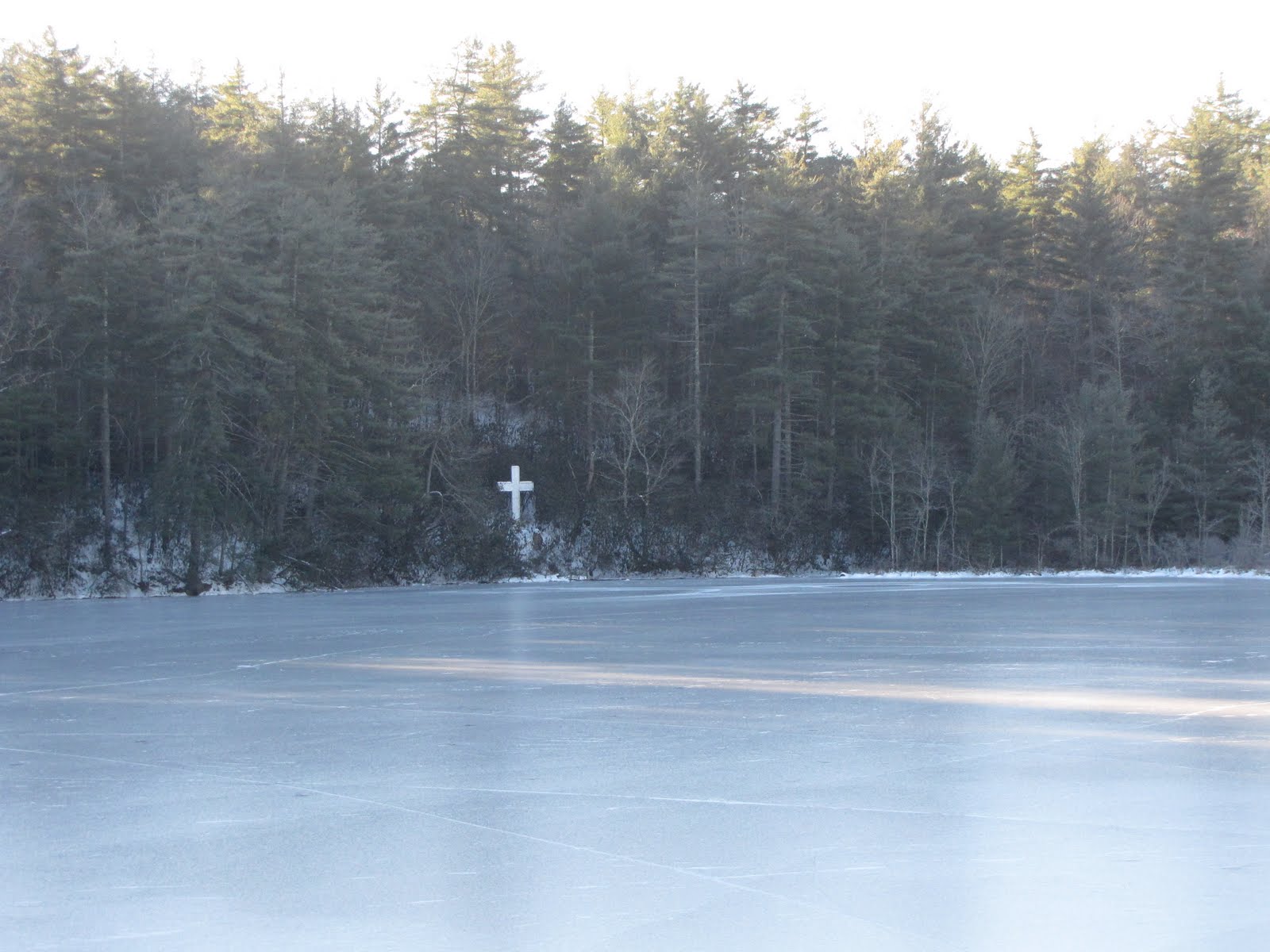
The first part of January of saw more snow fall in the South than we usually get in a dozen winters. Schools closed, roads closed, and airports closed, but Kanuga was blessedly and blissfully open, ready to welcome nearly 80 knitters and quilters for the retreat. A friend from Mississippi was one of the instructors, so we loaded up her car with suitcases and yarn and headed east.
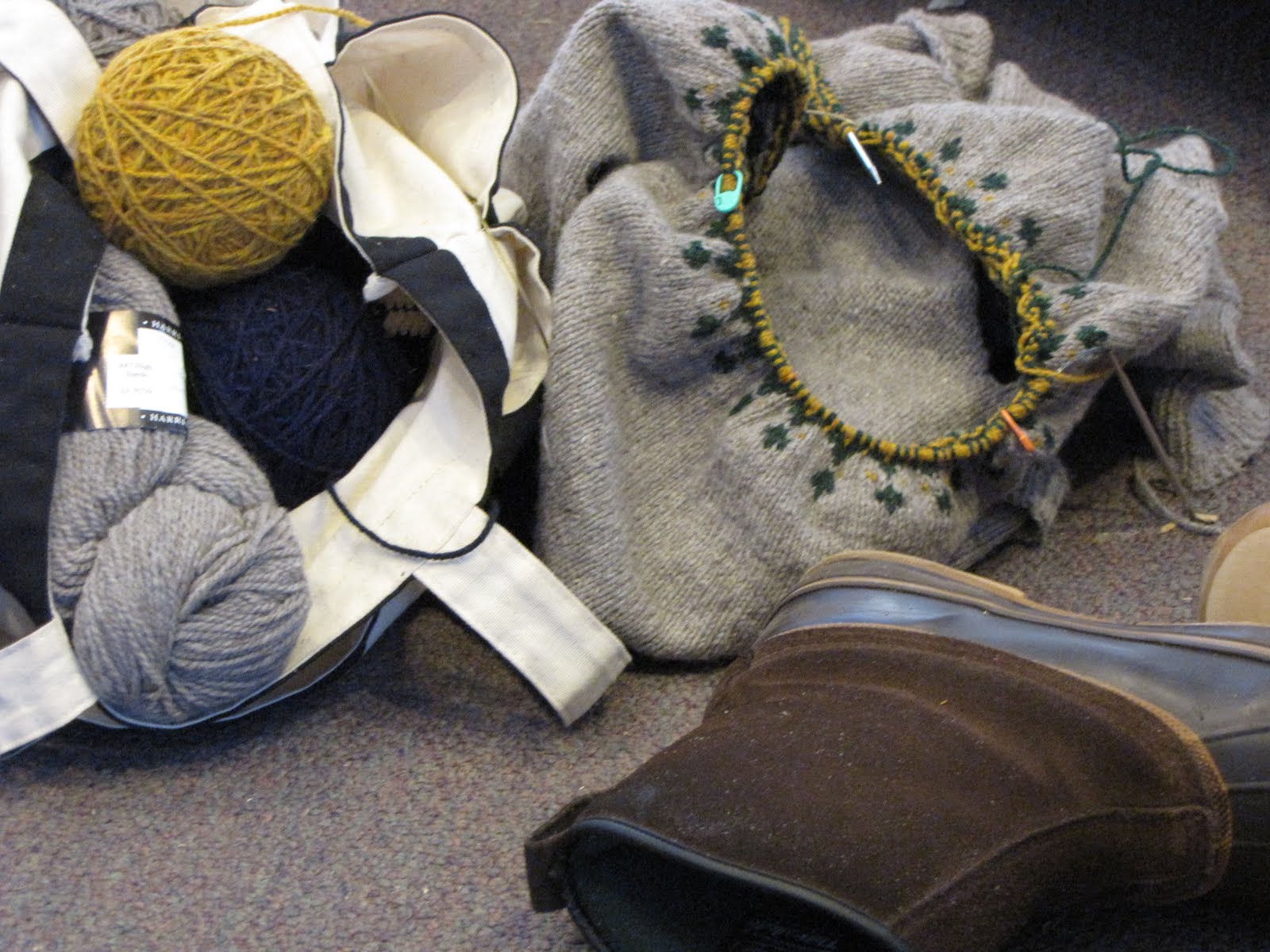
By the time we got to Atlanta, the icy interstate was down to one lane in each direction. Things were better nearer the mountains, where they know a little more about salt and sand and scraping, but still we risked life and limb to visit The Needle Tree in Greenville, SC. The steep driveway was sheer ice, but inside, the shop was cozy and bright and warm. And when you buy yarn from them (which we happily did) they tuck it in fabric bag complete with pockets on the side for needles and notions.
The retreat was amazing. The knitting instructors were masters at their craft, teaching such advanced techniques as intarsia, fair isle, mosaic knitting, and lace. My mom took a class on knitting the swirl shawl from an instructor as patient and kind as she is brilliant (mom just finished the shawl last week, and it is stunning!). I floated from class to class, getting to know participants and picking up bits and pieces of techniques, but mostly marveling at the skill and perseverance and good humor of everyone there.
The quilters were equally talented and even more dedicated, spending nearly every waking hour in the room set aside for their class. They loved visitors, and I loved visiting, learning as much about colors and shapes as I did about some of the steps involved in making a quilt. Many of the quilters finished an entire quilt top in the two and a half days we were there.
My role as chaplain was to offer worship services every morning and evening. We met in a lovely space with a fireplace in the back and great glass windows behind the altar, revealing the myriad ways sun illuminates snow as the day wears on. For the next few days, I'll post the little homilies I preached while I was there...
It's in the mid-90's today, and only getting hotter... Thank goodness the Kanuga Knitters and Quilters Retreat is only eight months away!
Subscribe to:
Posts (Atom)