Here is where I explain this little series of meditations...
Deuteronomy 8:6-10; Psalm 63; John 2:1-11
One of my favorite cinematic scenes is from the movie, Chocolat - actually, many of my favorite scenes are from that movie - when a table full of people who might not otherwise have sat down together are invited to dinner. A savory meal is served, and there is stunned silence as luscious dark chocolate is poured over the roast on every plate. Slowly and politely, the guests close their mouths around a first forkful, and in a moment as full of mystery and grace as what happens at the altar, the flavors mingle into something more than a meal to nourish the body. It is a strangely intimate scene as deep delight fills their faces, and they look at one another and smile. Their story lines have carried them through loss and longing, sickness and sin, humiliation, loneliness, and despair. But each has also learned that they are loved and capable of more than they ever imagined. That night they become friends. That night they taste communion.
Our sense of taste has the primal function of alerting us to foods that are energy-rich and foods that are poisonous, but most of the time it is the most luxurious of all our senses, enhancing our experience of the mundane and necessary act of eating. Hundreds of thousands of receptor cells in our taste buds recognize molecules in our food and register them as sweet, sour, salty, bitter, or savory. Then...well, that's actually about all we know for certain about the neurological path from the food we eat to the place in our brains where gustatory information is processed, which means, I guess, I have to accept my son's insistence that he doesn't know why he doesn't like Brussels sprouts, he just doesn't.
So how is Jennifer going to connect all this to knitting and quilting? She wasn't sure either, at first. "What wonders there are to behold," is the refrain we have repeated in our worship here, morning and evening, like so many psalmists before us in scripture. This world God made, by God's own admission, is very good, and we were given eyes and ears and noses and hands to delight in it, and so to delight in God. We see how beautifully the shades of blue in that quilt shift from dark to light, or how gently that instructor guides a knitter's hands to the next stitch. We hear the rhythmic hum of sewing machines, the soft sighs of an iron. We smell wool and suddenly remember a pair of mittens our grandmother made. We feel yarn flow through our fingers, fabric flow beneath our hands, the weight and warmth of a finished piece. What wonders there are to behold!
We taste...well, here is a wonder. Our physical sense of taste is so particular, so unique for each person, that we have come to use the word to describe our creative preferences, what we wear, how we decorate, what our favorite fibers or colors or patterns are. Quilter Susan Towner-Larsen describes creativity as a juicy process, like eating a Georgia peach when it's just-right-ripe, succulent and sweet, eaten outside or over a sink. We're aware of how the peach looks, how it smells, how it feels, how it sounds when we slurp its nectar in. We taste that peach as it fills us, and just as God in this delicious way nourishes our bodies, so does God also feed our souls a juicy capacity for creative expression according to our taste.
We are fed through all our senses, writes knitter Susan Gordon-Lyon. "From the first rhythm we hear, our mother's heartbeat, we expand our awareness and comprehension of the world around us, and we seek to duplicate its beauty and fathom its secrets by depicting it in symbols and patterns. Pioneer quilt makers expressed what they saw in their world: flying geese, tumbling blocks, double wedding rings, Virginia reels, as well as stories and myths that lent mystery to their lives, such as the story of Jacob's Ladder. In the intricate knitting combinations used in Aran sweaters, the names of the stitches tell stories of the knitter's world: marriage lines (up and down), honeycomb, blackberry vines, ocean waves, the tree of life."
What have you tasted? What are we called to create? Our faith is in a Word made Incarnate, who made the blind to see and the deaf to hear, turned water into wine, washed smelly feet, and touched the untouchable. In all the shapes we have cut and seams we have sewn and colors we have chosen and stitches we have knit here this weekend, this, the pattern of Christ, is what we have duplicated. This has been, and is, our best creative work: our listening to one another's stories as we stitched, our offering of helping hands, our seeing and celebrating each other's hard work, our prayers whispered, our laughter shared, our chocolate savored, our gathering here in this chapel.
At this table, as we celebrate our holy communion, we will see and hear and smell and touch and taste who we are - the Body of Christ, knit together from many and diverse threads, a beautiful patchwork of people, each of us loved and cherished by God. What wonders there are to behold.
And at this table, we can see and hear and smell and touch and taste who we also are - a community of knitters and quilters and the companions who came with us, women and men with the capacity to create, each according to our taste but all for the purpose of making the world more beautiful and warm and wrapped in love. It's more like a potluck than a sit-down dinner, for each of us brings something different and wonderful to the table - quilts, scarves, hats, humor, wisdom; different shapes, colors textures and fragrances; and many different tastes. Let us feast. What wonders there are to behold! Amen.
Sunday, January 15, 2017
Saturday, January 14, 2017
KKQ 2017: Saturday Evening, Touching
Here is where I explain this little series of meditations...
Psalm 139; Mark 6:53-56
"That's the thing about yarn," a knitter said to me Thursday night, after asking if she could touch the skein in my bag. "That's the thing about yarn," she said. "You have to touch it."
It's true, of course, as anyone who has ever walked into a yarn shop knows. You have to touch everything, even the yarns you don't intend to purchase in colors you'd never choose. Silk. Alpaca. Merino. Cashmere. Angora. Even the words are tactile. That's the thing about yarn.
I asked around the quilting room, and I learned it's the thing about fabric, too. "We have to feel the weave and weight," I was told, " even if we'd never use it. How could we not reach out and touch bolt after bolt of smooth batik, or color-saturated cotton, or crisp white linen?" What wonders there are to behold.
When the yarn and fabric come home with us, we touch every single inch, every single yard, as it becomes something constructed of stitches and intention. The yarn slides through our fingers on its way to be knitted; the fabric slides under our hands on its way to becoming a quilt. And when we're finished, we'll wrap ourselves or someone else in what we have made.
All the rest of our senses - sight and sound and smell and taste - are limited to a very small area - eyes and ears and nose and mouth. But touch happens everywhere: head to toe, right to left, back to front. Touch is unavoidable, as observed by the children in the movie Despicable Me, who upon being told to not touch anything ask impetuously, "What about the ground? Can I touch the ground? What about the air? Can I touch the air?"
Our skin is our largest sensory organ, with countless receptors primed for texture, movement, temperature and pressure - the smoothness of fabric, the tickle of a loose thread, the warmth of a wool scarf, the weight of an old quilt. It is a remarkable and vital layer of who we are, the boundary between us and everything that is not us. At the same time, our skin is impermeable and porous, inviolable and immensely vulnerable, protective against and responsive to the touch of others, tough and so very fragile.
And the world outside of us is textured as we press against us, or as it presses against us. Sometimes life is smooth and even, sometimes soft and warm. Other times it can feel stiff and unyielding, coarse or scratchy, tangled and torn. Sometimes it has worn so thin we're hanging by a thread. I do not have to tell you that sadness and weariness are so real that we can sometimes literally feel them as physical sensations. There are somatosensory receptors not only in our skin but in our bones, our joints, our vital organs. We don't just hurt. We feel hurt. We aren't just sad. We feel sorrow. We don't just mourn. We feel grief.
So it was that the Word became flesh and lived among us, we read in the gospel of John. Like us, it was only a layer of skin in Jesus Christ that separated God from all that was not God, and what wondrous things happened when Jesus touched us. People were able by his touch to seat hear, to speak, to walk, to stand up straight, to be made whole, and lest we worry that our touch is not so powerful, I submit to you that what he really did by his touch, by his placing of his hands upon another person's skin, was heal their darkness, their isolation, their forced silence, their overburdened-ness, their fear. By his touch, Jesus reminded people they were loved and cherished and that their well-being mattered, and he restored them to community. We can do that with our touch, too.
We know how what we do with our hands - our knitting, our quilting, our stitching - how it heals us, calms us, renews us, binds us together. Anne Lamott says that in our times of darkness or despair, stitching is "the finger and heart version of putting one foot in front of the other." We also know how what we do with our hands heals others when we wrap them in our prayer, our thoughts, our love, our scarves, our quilts. How touching even the fringe of a garment can make one well in heart and spirit. Anne Lamott goes on to write, "The world is always going to be dangerous, and people get badly banged up, but how can there be any more meaning than helping one another stand up in a wind and stay warm?"
That's the thing about yarn. That's the thing about fabric. That's the thing about being knit together in love and prayer through Jesus Christ. What wonders there are to behold. Amen.
Psalm 139; Mark 6:53-56
"That's the thing about yarn," a knitter said to me Thursday night, after asking if she could touch the skein in my bag. "That's the thing about yarn," she said. "You have to touch it."
It's true, of course, as anyone who has ever walked into a yarn shop knows. You have to touch everything, even the yarns you don't intend to purchase in colors you'd never choose. Silk. Alpaca. Merino. Cashmere. Angora. Even the words are tactile. That's the thing about yarn.
When the yarn and fabric come home with us, we touch every single inch, every single yard, as it becomes something constructed of stitches and intention. The yarn slides through our fingers on its way to be knitted; the fabric slides under our hands on its way to becoming a quilt. And when we're finished, we'll wrap ourselves or someone else in what we have made.
All the rest of our senses - sight and sound and smell and taste - are limited to a very small area - eyes and ears and nose and mouth. But touch happens everywhere: head to toe, right to left, back to front. Touch is unavoidable, as observed by the children in the movie Despicable Me, who upon being told to not touch anything ask impetuously, "What about the ground? Can I touch the ground? What about the air? Can I touch the air?"
Our skin is our largest sensory organ, with countless receptors primed for texture, movement, temperature and pressure - the smoothness of fabric, the tickle of a loose thread, the warmth of a wool scarf, the weight of an old quilt. It is a remarkable and vital layer of who we are, the boundary between us and everything that is not us. At the same time, our skin is impermeable and porous, inviolable and immensely vulnerable, protective against and responsive to the touch of others, tough and so very fragile.
And the world outside of us is textured as we press against us, or as it presses against us. Sometimes life is smooth and even, sometimes soft and warm. Other times it can feel stiff and unyielding, coarse or scratchy, tangled and torn. Sometimes it has worn so thin we're hanging by a thread. I do not have to tell you that sadness and weariness are so real that we can sometimes literally feel them as physical sensations. There are somatosensory receptors not only in our skin but in our bones, our joints, our vital organs. We don't just hurt. We feel hurt. We aren't just sad. We feel sorrow. We don't just mourn. We feel grief.
So it was that the Word became flesh and lived among us, we read in the gospel of John. Like us, it was only a layer of skin in Jesus Christ that separated God from all that was not God, and what wondrous things happened when Jesus touched us. People were able by his touch to seat hear, to speak, to walk, to stand up straight, to be made whole, and lest we worry that our touch is not so powerful, I submit to you that what he really did by his touch, by his placing of his hands upon another person's skin, was heal their darkness, their isolation, their forced silence, their overburdened-ness, their fear. By his touch, Jesus reminded people they were loved and cherished and that their well-being mattered, and he restored them to community. We can do that with our touch, too.
We know how what we do with our hands - our knitting, our quilting, our stitching - how it heals us, calms us, renews us, binds us together. Anne Lamott says that in our times of darkness or despair, stitching is "the finger and heart version of putting one foot in front of the other." We also know how what we do with our hands heals others when we wrap them in our prayer, our thoughts, our love, our scarves, our quilts. How touching even the fringe of a garment can make one well in heart and spirit. Anne Lamott goes on to write, "The world is always going to be dangerous, and people get badly banged up, but how can there be any more meaning than helping one another stand up in a wind and stay warm?"
That's the thing about yarn. That's the thing about fabric. That's the thing about being knit together in love and prayer through Jesus Christ. What wonders there are to behold. Amen.
KKQ 2017: Saturday Morning, Smelling
Here is where I explain this little series of meditations...
Psalm 45; Luke 15:17-24
If I told you this was going to be a spiritual meditation on our sense of smell...I know, I'd be a little skeptical, too. Then again, I don't think I'm alone in believing the smell of hot coffee and sizzling bacon in the morning is a spiritual experience.
It's just that there aren't that many fragrances in scripture, other than a little incense in the temple, a little frankincense and myrrh, and the oil a woman once poured over Jesus' feet. The Ignatian tradition of prayer, from the 17th century, invites us to enter scripture more deeply, to read with all our senses, so that we might imagine the smell of the fruit in Adam and Eve's hands, or the odor of an ark full of animals, of dust and sweat covered disciples, the earthiness of a vineyard or the sweetness of a wheat field, the smell of fish being cooked over a fire on the beach, or the fatted calf prepared for feast when a prodigal has returned.
It's also an unusual subject for a meditation because our sense of smell is so personal, almost uncomfortably intimate. Unlike seeing or hearing, which can be done at a distance, we have to be pretty close to something to smell it (except, bless them, for skunks and 16-year-old son's laundry baskets). And smells, unlike light or sound, linger - they hover in the air as particles, not waves, entering over and over again into our bodies through our noses as we perform the simple but necessary act of breathing. Odors can be absorbed into fabrics and hair and skin, and so can remain long after the source of the odor is gone.
So it's a little strange to meditate on how our noses help us notice God. But then again, has the smell of something wonderful ever stopped us in our work, slowed and deepened our inhaling, made us close our eyes to focus on the fragrance? Maybe lilacs or lavender, pine needles or pumpkin spice, that first whiff of sea air, a newborn's head, or warm chocolate cake? We have noses for a reason, and if it is in part to sniff out danger, it must also be for the sake of delight, a gift from God, and a part of how we come to know the world.
The intimacy of smell is literally deeply physical, far more than just our proximity to something fragrant. Receptor cells are triggered, and the impulses they send travel through our limbic system, the most primal part of our bodies, to which, in our brains, the hippocampus and amygdala are attached. These perform associative thinking and process emotion, and together they make memories. When we smell something, our brains, unbidden, whip that fragrance together with how we're feeling or where we are or who we're with, so that when we smell that thing again, we are immediately transported back to that time or person or place. The oil and heat of a sewing machine smell like our grandmother's house. The wool I bought on Iona smells just like being there. The smoke wafting from a neighbor's chimney back home smells like the fireplace lounge here. The tomato sauce at dinner takes us back to our grandfather's kitchen. Your WindSong literally stays on my mind.
If all of this isn't enough to convince us to consider our noses as a spiritual gift, there are a few other passages in scripture that speak of smell. From the letter to the Ephesians, "Walk in love, as Christ loved us and gave himself for us as a fragrant offering to God." And from the second letter to the Corinthians, "For we are the aroma of Christ to God among those who are being saved." We are the aroma of Christ, the aroma of love, the fragrance of offering and sacrifice. How profoundly intimate. In the movie Michael, the archangel smells like cookies to people around him. What does it mean to smell like someone who follows Christ?
In some Episcopal Churches it very well may mean to smell a little like frankincense, so thick are the clouds of it hanging in the air. Mostly, I think, carrying the aroma of Christ has to do with letting kindness and mercy and grace waft between us and linger on us, so that anyone who wanders our way senses welcome, as when we smell something that reminds us of home. A blessing in the service of morning prayer we use at the Cathedral says, "Live so that those to whom love is a stranger will find in us generous friends."
What will we smell today? Please do respect personal space! But amidst the aromas of steam and warm fabric, wooden needles and wool, bread and wine and breakfast and mountain air, perhaps we will also breathe in Christ. What wonders there are to behold! Amen.
Psalm 45; Luke 15:17-24
If I told you this was going to be a spiritual meditation on our sense of smell...I know, I'd be a little skeptical, too. Then again, I don't think I'm alone in believing the smell of hot coffee and sizzling bacon in the morning is a spiritual experience.
It's just that there aren't that many fragrances in scripture, other than a little incense in the temple, a little frankincense and myrrh, and the oil a woman once poured over Jesus' feet. The Ignatian tradition of prayer, from the 17th century, invites us to enter scripture more deeply, to read with all our senses, so that we might imagine the smell of the fruit in Adam and Eve's hands, or the odor of an ark full of animals, of dust and sweat covered disciples, the earthiness of a vineyard or the sweetness of a wheat field, the smell of fish being cooked over a fire on the beach, or the fatted calf prepared for feast when a prodigal has returned.
It's also an unusual subject for a meditation because our sense of smell is so personal, almost uncomfortably intimate. Unlike seeing or hearing, which can be done at a distance, we have to be pretty close to something to smell it (except, bless them, for skunks and 16-year-old son's laundry baskets). And smells, unlike light or sound, linger - they hover in the air as particles, not waves, entering over and over again into our bodies through our noses as we perform the simple but necessary act of breathing. Odors can be absorbed into fabrics and hair and skin, and so can remain long after the source of the odor is gone.
So it's a little strange to meditate on how our noses help us notice God. But then again, has the smell of something wonderful ever stopped us in our work, slowed and deepened our inhaling, made us close our eyes to focus on the fragrance? Maybe lilacs or lavender, pine needles or pumpkin spice, that first whiff of sea air, a newborn's head, or warm chocolate cake? We have noses for a reason, and if it is in part to sniff out danger, it must also be for the sake of delight, a gift from God, and a part of how we come to know the world.
The intimacy of smell is literally deeply physical, far more than just our proximity to something fragrant. Receptor cells are triggered, and the impulses they send travel through our limbic system, the most primal part of our bodies, to which, in our brains, the hippocampus and amygdala are attached. These perform associative thinking and process emotion, and together they make memories. When we smell something, our brains, unbidden, whip that fragrance together with how we're feeling or where we are or who we're with, so that when we smell that thing again, we are immediately transported back to that time or person or place. The oil and heat of a sewing machine smell like our grandmother's house. The wool I bought on Iona smells just like being there. The smoke wafting from a neighbor's chimney back home smells like the fireplace lounge here. The tomato sauce at dinner takes us back to our grandfather's kitchen. Your WindSong literally stays on my mind.
If all of this isn't enough to convince us to consider our noses as a spiritual gift, there are a few other passages in scripture that speak of smell. From the letter to the Ephesians, "Walk in love, as Christ loved us and gave himself for us as a fragrant offering to God." And from the second letter to the Corinthians, "For we are the aroma of Christ to God among those who are being saved." We are the aroma of Christ, the aroma of love, the fragrance of offering and sacrifice. How profoundly intimate. In the movie Michael, the archangel smells like cookies to people around him. What does it mean to smell like someone who follows Christ?
In some Episcopal Churches it very well may mean to smell a little like frankincense, so thick are the clouds of it hanging in the air. Mostly, I think, carrying the aroma of Christ has to do with letting kindness and mercy and grace waft between us and linger on us, so that anyone who wanders our way senses welcome, as when we smell something that reminds us of home. A blessing in the service of morning prayer we use at the Cathedral says, "Live so that those to whom love is a stranger will find in us generous friends."
What will we smell today? Please do respect personal space! But amidst the aromas of steam and warm fabric, wooden needles and wool, bread and wine and breakfast and mountain air, perhaps we will also breathe in Christ. What wonders there are to behold! Amen.
Friday, January 13, 2017
KKQ 2017: Friday Evening, Hearing
Here is where I explain this little series of meditations...
Psalm 78; 1 Samuel 3:1-11
"One, two, yarn over...one, two, knit two together...one, two, three...no, wait..." Sigh.
If I gave my meditations titles, this one would be, 'Things I heard at Kanuga Today.'
"You mean I have to take the whole row out?"
"I did it!"
"Those colors look beautiful together."
"Seriously, we're eating again already?!"
I heard needles clicking, sewing machines humming, stitch markers clinking, irons sighing, instructors patiently explaining, people laughing and telling stories, toast crunching, bugles sounding, birds singing, prayers said together, and silence being shared comfortably. All the sounds you would expect at a knitting and quilting retreat. At Kanuga, anyway - I don't know if every retreat center has bugles and special toast.
What wonders there are to behold, our sense of hearing among them - delicate with narrow canals and tiny bones, hair-like fibers and skin stretched tight as a drum, detecting the movement of sound in the air. Vibrations become nerve impulses, and nerve impulses become thoughts, and the thoughts become...this is my favorite song...my friend is speaking...someone is crying...the wind is howling...will that dog ever stop barking...
Knitting and quilting are relatively quiet pursuits, and at the same time filled with sounds: scissors snipping and yarn flapping and yarn swifts spinning. True quiet, in fact, is hard, if not impossible, to come by in our noisy world of phones ringing and devices dinging; of traffic and train whistles and planes making their final approach; of talk shows, bass lines, videos that start playing when you haven't even clicked on them, experts arguing on the news, sirens, gun shots, car alarms. We've even learned to shout silently when we write a text or email in all caps.
There's lots of noise out there, and unlike our sense of sight, which we turn off by closing our eyes, our ears are always perceiving the sounds that bombard us, even while we sleep. The Reverend Barbara Brown Taylor laments how difficult it is to find true darkness or true silence, so pervasive are waves of light and sound all around us. They come at us with such velocity, she writes, that we have to defend ourselves against them, and may become so calloused that we no longer see or hear, even when our eyes our open and our ears unstopped.
And even if we could shut out sound, there's lots of noise inside ourselves as well. We can close every door and turn off everything that hums or beeps or ticks and tocks, but then the volume of our thoughts turns up, and while those tiny bones in our ears don't hear them, somehow it still registers as sound.
How then do we listen, for surely not every sound is an imposition. God did not create a world that stays silent. Waves crash, leaves rustle, bees buzz, people sing. And even God, in so many stories we read in scripture...even God has a voice. How do we listen?
That's what we asked a seminary professor who was teaching contemplative prayer. We were to sit in silence, he said, and obediently, we tried...in our classroom on 9th Avenue in New York City. It was evening, and outside the open window, people were passing by, talking and laughing loudly. A truck idled at the corner and then began beeping its backing-up-warning. A light must have changed, because traffic picked up, and it was surely a yellow cab that honked. A car alarm was set off as another large truck lumbered by. "We can't do it," we said. "How can we hear God when there is so much noise?"
Our professor smiled. He knew we'd ask. "Are you sure you can't hear God? Listen differently," he said. "Pray the noise. Those people passing by? Pray for them - who knows what burdens they carry. Those trucks are delivering some kind of goods or services - pray for those who go without. The traffic, the horns - pray for the safety of all who travel. The sirens, the alarms - pray for all who are in danger, and for those who go to their aid."
Speak, for your servant is listening. God's voice comes in countless ways, even in scripture - there is that still, small voice, yes, but there is also thunder and angel song and the words of teachers, friends, and strangers. Listen differently, it's as if Eli said to Samuel. Are you sure you aren't hearing God's voice? Listen differently, God says to us. What will we hear?
Needles clicking? Pray for the person whose head that hat will warm. A sewing machine? Pray for the family whose loved one wore the t-shirts that are becoming a quilt. A bugle call? Pray for the staff who cooked our food.
Speak, Lord, for your servants are listening. What wonders there are to behold! Amen.
Psalm 78; 1 Samuel 3:1-11
"One, two, yarn over...one, two, knit two together...one, two, three...no, wait..." Sigh.
If I gave my meditations titles, this one would be, 'Things I heard at Kanuga Today.'
"You mean I have to take the whole row out?"
"I did it!"
"Those colors look beautiful together."
"Seriously, we're eating again already?!"
I heard needles clicking, sewing machines humming, stitch markers clinking, irons sighing, instructors patiently explaining, people laughing and telling stories, toast crunching, bugles sounding, birds singing, prayers said together, and silence being shared comfortably. All the sounds you would expect at a knitting and quilting retreat. At Kanuga, anyway - I don't know if every retreat center has bugles and special toast.
What wonders there are to behold, our sense of hearing among them - delicate with narrow canals and tiny bones, hair-like fibers and skin stretched tight as a drum, detecting the movement of sound in the air. Vibrations become nerve impulses, and nerve impulses become thoughts, and the thoughts become...this is my favorite song...my friend is speaking...someone is crying...the wind is howling...will that dog ever stop barking...
Knitting and quilting are relatively quiet pursuits, and at the same time filled with sounds: scissors snipping and yarn flapping and yarn swifts spinning. True quiet, in fact, is hard, if not impossible, to come by in our noisy world of phones ringing and devices dinging; of traffic and train whistles and planes making their final approach; of talk shows, bass lines, videos that start playing when you haven't even clicked on them, experts arguing on the news, sirens, gun shots, car alarms. We've even learned to shout silently when we write a text or email in all caps.
There's lots of noise out there, and unlike our sense of sight, which we turn off by closing our eyes, our ears are always perceiving the sounds that bombard us, even while we sleep. The Reverend Barbara Brown Taylor laments how difficult it is to find true darkness or true silence, so pervasive are waves of light and sound all around us. They come at us with such velocity, she writes, that we have to defend ourselves against them, and may become so calloused that we no longer see or hear, even when our eyes our open and our ears unstopped.
And even if we could shut out sound, there's lots of noise inside ourselves as well. We can close every door and turn off everything that hums or beeps or ticks and tocks, but then the volume of our thoughts turns up, and while those tiny bones in our ears don't hear them, somehow it still registers as sound.
How then do we listen, for surely not every sound is an imposition. God did not create a world that stays silent. Waves crash, leaves rustle, bees buzz, people sing. And even God, in so many stories we read in scripture...even God has a voice. How do we listen?
That's what we asked a seminary professor who was teaching contemplative prayer. We were to sit in silence, he said, and obediently, we tried...in our classroom on 9th Avenue in New York City. It was evening, and outside the open window, people were passing by, talking and laughing loudly. A truck idled at the corner and then began beeping its backing-up-warning. A light must have changed, because traffic picked up, and it was surely a yellow cab that honked. A car alarm was set off as another large truck lumbered by. "We can't do it," we said. "How can we hear God when there is so much noise?"
Our professor smiled. He knew we'd ask. "Are you sure you can't hear God? Listen differently," he said. "Pray the noise. Those people passing by? Pray for them - who knows what burdens they carry. Those trucks are delivering some kind of goods or services - pray for those who go without. The traffic, the horns - pray for the safety of all who travel. The sirens, the alarms - pray for all who are in danger, and for those who go to their aid."
Speak, for your servant is listening. God's voice comes in countless ways, even in scripture - there is that still, small voice, yes, but there is also thunder and angel song and the words of teachers, friends, and strangers. Listen differently, it's as if Eli said to Samuel. Are you sure you aren't hearing God's voice? Listen differently, God says to us. What will we hear?
Needles clicking? Pray for the person whose head that hat will warm. A sewing machine? Pray for the family whose loved one wore the t-shirts that are becoming a quilt. A bugle call? Pray for the staff who cooked our food.
Speak, Lord, for your servants are listening. What wonders there are to behold! Amen.
KKQ 2017: Friday Morning, Seeing
Here we are again - another series of short meditations on knitting and quilting and toast, because here I am again - serving as chaplain at the Kanuga Knitting and Quilting Retreat. This year's theme for our morning and evening worship was "What Wonders There Are to Behold," exploring God's creation (which is mostly to say, again, knitting and quilting and toast) through each of the five senses.
Psalm 104; John 9:1-10
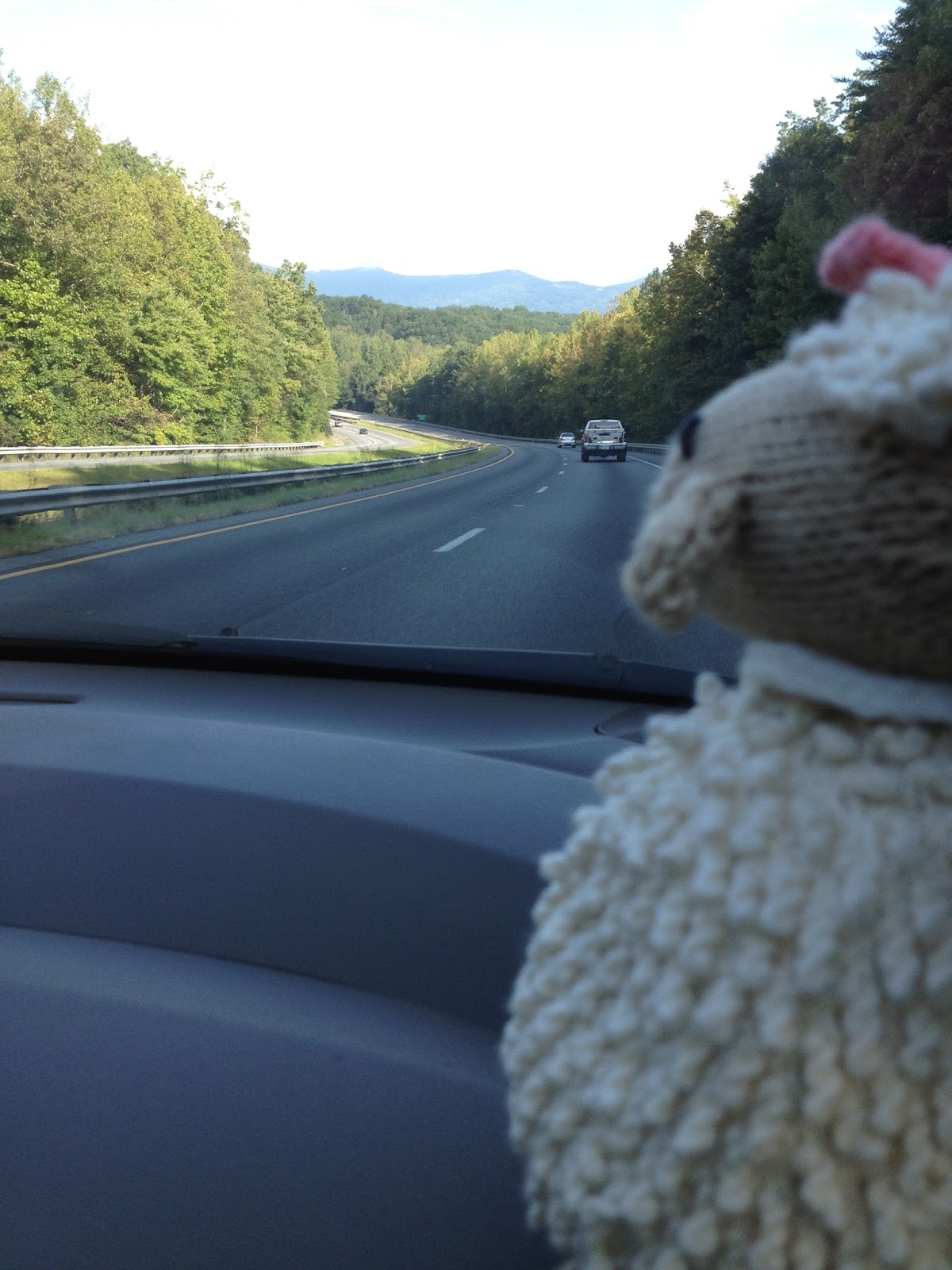
Sometimes I remember to look for it, and other times I forget that I'll see it - that first sight of real, true mountains somewhere beyond Birmingham along Interstate 20, as we make our way from Jackson, MS, to Kanuga. I love that moment, and whether I've been watching the scenery or not, anticipating their appearance, the sight of those mountains instantly fills me with delight, no matter how much Alabama road construction I'm navigating. I can't help but smile, and breathe more deeply, and relax my grip on the steering wheel just a little, along with my grip on whatever has been occupying my thoughts. And inside the car with its recycled air, I'm smelling evergreens and layers of leaves, feeling the movement of a rocking chair, hearing silence broken only by birdsong, tasting morning's first bite of toast.
What wonders there are to behold, so many of the psalmists sang, marveling at all God has made, including ourselves, made with eyes and ears and noses and hands and mouths for beholding God's wonders. God could have mountains for God's own delight - do you remember, in Genesis, how very often we are told that God look at what had been made and called it good, very good? - but so great was God's delight that it could not be reserved for God alone. We are created with an extraordinary capacity to experience and be transformed by the wonders of this world.
Our bodies are filled with and covered in specialized cells, remarkable receptors for light and sound and smells and touch and taste. They take in everything around us and send it as electrical impulses to our brains, where what we experience is shaped into images, memories, knowledge, and insight, a patchwork of color and scent and soft or rough, a weaving of sounds and sweetness and saltiness and wonder.
What we see makes up as much as 75 percent of what we perceive - it is the sense, when our eyes are healthy and open, that we rely upon most. And our eyes are up to the task, each one made up of millions of working parts. We are so conditioned to respond to visual stimuli that when we understand something, we say, "I see."
So what do we see? I wonder if, most of the time, the better question is, what do we not see? What are we so focused on that we're blind to everything else, like the people in the gospel story who only recognize the blind man by his blindness, and not by any other characteristic?
God's vision contained an entire creation, and each individual element in it. So are we, made in God's image, capable of extraordinary sight. We can take in such big pictures as a beautiful lake...and notice any number of details, like the play of light on wind-driven ripples, the perfect reflection of clouds and sky when the lake is still, the infinite number of shades of green among the trees along the shore. A conference room full of people...and the way a smile grows on the face of the person sitting beside us. A finished quilt so large it takes two people to hold it up...and how the quilter cut the fabric in that one square to keep the blue flower intact. A whole row of stitches perfectly (or mostly-perfectly) executed...and the way that knit-two-together leans just a little to the right (don't worry, it's supposed to do that). A pattern we just aren't sure we can master...and the next step in that pattern, which we can.
Perhaps it does take time to recognize our ability to see, to allow our sense of sight to inspire us and not merely inform us. Here, on retreat, we are given just such a gift. If, and I'm not saying this is likely, but if we get caught up in anxiety over the numbers and words and patterns of this day, in the same way we can so easily get caught up in the to-do lists and appointments and obligations of our daily lives away from here...if all we can see is what doesn't delight us, Leo Tolstoy wrote, "In the name of God, stop a moment, close your work, look around you."
What will we see today? The hands at work beside us, how they hold the yarn just so, or move their fabric past the needle with such care. The last of the snow hiding in the cool shade of a cottage. The dropped stitch, the crooked seam...and the people all around us who can help. The bird riding a current above the lake. The pink yarn so saturated we can't look away. The dance of flames in a fireplace.
In the name of God, look around. What wonders there are to behold! Amen.
Psalm 104; John 9:1-10
Sometimes I remember to look for it, and other times I forget that I'll see it - that first sight of real, true mountains somewhere beyond Birmingham along Interstate 20, as we make our way from Jackson, MS, to Kanuga. I love that moment, and whether I've been watching the scenery or not, anticipating their appearance, the sight of those mountains instantly fills me with delight, no matter how much Alabama road construction I'm navigating. I can't help but smile, and breathe more deeply, and relax my grip on the steering wheel just a little, along with my grip on whatever has been occupying my thoughts. And inside the car with its recycled air, I'm smelling evergreens and layers of leaves, feeling the movement of a rocking chair, hearing silence broken only by birdsong, tasting morning's first bite of toast.
What wonders there are to behold, so many of the psalmists sang, marveling at all God has made, including ourselves, made with eyes and ears and noses and hands and mouths for beholding God's wonders. God could have mountains for God's own delight - do you remember, in Genesis, how very often we are told that God look at what had been made and called it good, very good? - but so great was God's delight that it could not be reserved for God alone. We are created with an extraordinary capacity to experience and be transformed by the wonders of this world.
Our bodies are filled with and covered in specialized cells, remarkable receptors for light and sound and smells and touch and taste. They take in everything around us and send it as electrical impulses to our brains, where what we experience is shaped into images, memories, knowledge, and insight, a patchwork of color and scent and soft or rough, a weaving of sounds and sweetness and saltiness and wonder.
What we see makes up as much as 75 percent of what we perceive - it is the sense, when our eyes are healthy and open, that we rely upon most. And our eyes are up to the task, each one made up of millions of working parts. We are so conditioned to respond to visual stimuli that when we understand something, we say, "I see."
So what do we see? I wonder if, most of the time, the better question is, what do we not see? What are we so focused on that we're blind to everything else, like the people in the gospel story who only recognize the blind man by his blindness, and not by any other characteristic?
God's vision contained an entire creation, and each individual element in it. So are we, made in God's image, capable of extraordinary sight. We can take in such big pictures as a beautiful lake...and notice any number of details, like the play of light on wind-driven ripples, the perfect reflection of clouds and sky when the lake is still, the infinite number of shades of green among the trees along the shore. A conference room full of people...and the way a smile grows on the face of the person sitting beside us. A finished quilt so large it takes two people to hold it up...and how the quilter cut the fabric in that one square to keep the blue flower intact. A whole row of stitches perfectly (or mostly-perfectly) executed...and the way that knit-two-together leans just a little to the right (don't worry, it's supposed to do that). A pattern we just aren't sure we can master...and the next step in that pattern, which we can.
Perhaps it does take time to recognize our ability to see, to allow our sense of sight to inspire us and not merely inform us. Here, on retreat, we are given just such a gift. If, and I'm not saying this is likely, but if we get caught up in anxiety over the numbers and words and patterns of this day, in the same way we can so easily get caught up in the to-do lists and appointments and obligations of our daily lives away from here...if all we can see is what doesn't delight us, Leo Tolstoy wrote, "In the name of God, stop a moment, close your work, look around you."
What will we see today? The hands at work beside us, how they hold the yarn just so, or move their fabric past the needle with such care. The last of the snow hiding in the cool shade of a cottage. The dropped stitch, the crooked seam...and the people all around us who can help. The bird riding a current above the lake. The pink yarn so saturated we can't look away. The dance of flames in a fireplace.
In the name of God, look around. What wonders there are to behold! Amen.
Monday, January 18, 2016
KKQ 2016: Monday Morning, Season after Pentecost
Here is where I explain what this little series of posts is all about.
Monday Morning, Season after Pentecost
Psalm 104; John 14:8-20
For everything there is a season... On our church calendar, we're still in Epiphany. But in KKQ time...it's the Season after Pentecost. The long, slow season when Easter's alleluias and Pentecost's fires have faded, and we are faced with ordinariness once again. The long, slow season when Kanuga's toast isn't on our breakfast plates and we aren't surrounded day and night with other knitters and quilters, and we are faced with work or school or cooking dinner or cleaning up or whatever else it is that keeps us from stitching.
The Season after Pentecost, the season after Kanuga, is the longest season of the year. It's where we spend most of our lives, day in and day out, with good days and bad days, long days and whirlwinds, celebrations, distractions, steady progress, standing still. Some days it can seem like we're slogging through, like when we knit a thousand rows and our sweater only grows half an inch, or sew a thousand rectangles on a border that only reachers halfway down one side of our quilt. Other days, though, are the ones about which we've been telling each other stories all weekend. The day a grandchild was born. The day a wedding was held. A house was sold. A surgery was undertaken. A shawl was worn. A quilt was finished. A prayer was answered. A prayer was asked.
On the Sundays in this long season, as we go about our ordinary days, we will hear story after story about how Jesus went about his ordinary days. The gospel record for us healing and teachings, journeys and resting places, excitement and anger. How might we record, in this slow season, what we have done? One knitter has imagined might pause in our work from time to time, lay out what we have done, look at where we've been and how far we've come. Whether it seems we made progress or none at all, we might pin a note to our work at the end of the day at the end of our last row, on the last piece we sew to our quilt. "My high school best friend called out of the blue today." My neighbor across the street died. I got a new puppy today. Our son started kindergarten. I fell in love again. All of these things, day by day, will be part of our stitching, woven into our hearts and our handwork.
And Christ will be part of all those things, and part of our stitching, too. His story unfolds in ordinary days, and he promises that the Spirit abides with us, not just on mountaintops like this one but in the long, slow season.
When we return home, it is not just our everyday work that will be waiting. Our yarn and our fabric are also there - I know you, I know we all have a stash. The season after Pentecost may be long and slow, but that is what growth requires. It is a fertile season, when things take root and unfold and become.
Saint Elizabeth Zimmerman wrote, "I reconnoitered my wool-room yesterday - it is full of possibilities for the new year... By this time next year some of these will have been achieved and some scorned and abandoned. Some as yet undreamed-of whims will have taken shape. I'm ready for them; my mind is open, my wool-room full of wool, my needles poised, my brain spinning like a Catherine-wheel. My word, such good fortune. I can only hope the same for you." Amen.
Monday Morning, Season after Pentecost
Psalm 104; John 14:8-20
For everything there is a season... On our church calendar, we're still in Epiphany. But in KKQ time...it's the Season after Pentecost. The long, slow season when Easter's alleluias and Pentecost's fires have faded, and we are faced with ordinariness once again. The long, slow season when Kanuga's toast isn't on our breakfast plates and we aren't surrounded day and night with other knitters and quilters, and we are faced with work or school or cooking dinner or cleaning up or whatever else it is that keeps us from stitching.
The Season after Pentecost, the season after Kanuga, is the longest season of the year. It's where we spend most of our lives, day in and day out, with good days and bad days, long days and whirlwinds, celebrations, distractions, steady progress, standing still. Some days it can seem like we're slogging through, like when we knit a thousand rows and our sweater only grows half an inch, or sew a thousand rectangles on a border that only reachers halfway down one side of our quilt. Other days, though, are the ones about which we've been telling each other stories all weekend. The day a grandchild was born. The day a wedding was held. A house was sold. A surgery was undertaken. A shawl was worn. A quilt was finished. A prayer was answered. A prayer was asked.
On the Sundays in this long season, as we go about our ordinary days, we will hear story after story about how Jesus went about his ordinary days. The gospel record for us healing and teachings, journeys and resting places, excitement and anger. How might we record, in this slow season, what we have done? One knitter has imagined might pause in our work from time to time, lay out what we have done, look at where we've been and how far we've come. Whether it seems we made progress or none at all, we might pin a note to our work at the end of the day at the end of our last row, on the last piece we sew to our quilt. "My high school best friend called out of the blue today." My neighbor across the street died. I got a new puppy today. Our son started kindergarten. I fell in love again. All of these things, day by day, will be part of our stitching, woven into our hearts and our handwork.
And Christ will be part of all those things, and part of our stitching, too. His story unfolds in ordinary days, and he promises that the Spirit abides with us, not just on mountaintops like this one but in the long, slow season.
When we return home, it is not just our everyday work that will be waiting. Our yarn and our fabric are also there - I know you, I know we all have a stash. The season after Pentecost may be long and slow, but that is what growth requires. It is a fertile season, when things take root and unfold and become.
Saint Elizabeth Zimmerman wrote, "I reconnoitered my wool-room yesterday - it is full of possibilities for the new year... By this time next year some of these will have been achieved and some scorned and abandoned. Some as yet undreamed-of whims will have taken shape. I'm ready for them; my mind is open, my wool-room full of wool, my needles poised, my brain spinning like a Catherine-wheel. My word, such good fortune. I can only hope the same for you." Amen.
| Tiny felted heart left on the windowsill in the chapel. |
Sunday, January 17, 2016
KKQ 2016: Sunday Morning, Easter
Here is where I explain this little series of posts.
Sunday Morning, Easter
1 Corinthians 12:1-11; Psalm 36:5-10; John 20:1-18
Now there are varieties of gifts, wrote Paul, who often said that his gift was weakness. There are varieties of gifts, but the same spirit, the same God who activates them all in everyone.
I learned, just yesterday in Mimi's class, that one of my gifts is mis-reading a knitting pattern. I am calling it a gift because Mimi's one classroom rule is that you cannot talk down about yourself. Perhaps others of you, whether knitters or quilters, have my same gift. It isn't that we do not understand the techniques we're being taught. It's not that we cannot execute them. It's simply that we have a gift...of not seeing what is right in front of us on the page.
Many of the projects we tackled this weekend demanded our best efforts. I saw all of you hard at work in your classrooms, sewing curved seams, knitting brioche, arranging quilt squares, making fingers on gloves. I chose Fox Paws for my project, and with the others in Mimi's class I cast on and started knitting.
So, until you reach row ten of that pattern - row ten, after nine grueling rows of knit-one-yarn-over-knit-one-in-the-same-stitch, slip-back-two, change colors, weave in the ends as you go... Until you reach row ten of Fox Paws, it's a hot mess. There are bunched up stitches everywhere, looking nothing at all like the pattern picture, and the only way to tell if you're knitting it correctly is to count, and then to pray. When you get to row ten, suddenly you see them, those little fox paws, which had been there all along.
Supposing him to be the gardener... I love this little detail in John's Easter story. Supposing him to be the gardener. Mary Magdalene, alone at the tomb, already grieving and now also anxious to find her Lord...Mary Magdalene turns away from a vision of angels to see a man standing nearby. Supposing him to be the gardener...Mary is gifted, too. She does not see what is right in front of her. She did not know that it was Jesus, John explains, and scholars and preachers have often said it was because resurrection was not a category she knew, that she did not recognize him because it couldn't possibly be him.
Others, including Lutheran pastor Nadia Bolz-Weber, give Mary more credit than that. Though Jesus clearly knew a little bit about growing wheat and grapes, or so it seemed from the stories he told, he was definitely not in the plant business. Mary thought he was the gardener, Bolz-Weber believes, because he looked like a gardener, which is to say, he was a mess. In icons and stained glass windows, the two of them stand face to face. Jesus is dressed all in white, with flowing hair, his face clean, his halo shining. But if Mary supposed him to be a gardener, he must have looked a little rough, the way we do when we're pulling weeds. Dirt under our nails, on our faces and between our toes; the hem of our pants (or his robe) soaking wet from the grass, maybe wearing a hat or carrying a hoe, with bits of leaves and twigs in our hair.
It was an understandable mistake, perhaps. God had been a gardener before, of course, in the very beginning, when God planted the seeds of all that would take root and grow and flower into creation. How fitting that on the day of resurrection, when creation was made new, infused not with time but eternity, that God would appear as a gardener again. Mary did not see Jesus until he called her name, and then suddenly there he was, right in front of her all along.
For everything there is a season... In all seasons, there is Easter. Every Sunday on our church calendar, whether in Advent or Lent or any other time of year...every Sunday is called a "little Easter", when we gather again to remember that Jesus died, yes, but also that he rose, re-creating us, and it is on this side of Easter that we now live - not just every Sunday, but every day.
Which is not, of course, to say that every day we look our best, as we do for "big" Easter, in our white dresses and pastel ties, lily-fresh. It may be that here, on retreat, we've been more appropriately dressed to find our risen Savior. If Mary, who had seen him face to face, supposed him that day to be a gardener, how many times, on how many days, have we look at Christ right in front of us not knowing that he was there? In the smile of the server in the dining hall. In the patience of our teachers here. In the stranger who has now become a friend. Singer-songwriter Carrie Newcomer writes, "God walks round in muddy boots, sometimes rags, and that's the truth. You can't always tell, but sometimes you just know."
Resurrection is messy. There are scars. There is misunderstanding. There is the business of becoming a new creation. There is meeting Christ on a morning in the midst of grief and confusion. And there is finally leaving the place where we saw him. In the Fox Paws pattern, row one comes around again eventually. And for a time the stitches will once again be all bunched up and difficult to work. But now we know the little paws are in there.
Jesus the Gardener sent Mary out to tell what she had seen. And she went, and it very well may be that we have a gospel to read at all because she announced to the others that Christ had risen and that they would see him going ahead of them. And when indeed they did, Jesus said he would be with them always, even to the end of the age.
Mary was gifted. And so are we. And I don't just mean that sometimes we don't see what's right in front of us. Mary had the gift of courage to tell the story of resurrection, as unbelievable as it sounded. Some of us have the gift of patience to teach. Others listen well, or start good fires in fireplaces, or elicit smiles, or are gifted at encouragement. We are all of us creative, and we all are able to wrap the world around us in warmth and color and generosity - or what else are we doing when we give someone a sweater or a hat or a quilt?
I hope there is new life in you today, at the end of this wonderful weekend we've shared. We've walked in the shadows of mountains and trees, we've not had to cook even once, we've sat by fireplaces, we've talked with friends, we've napped, we've shopped, we've walked in the snow, we've stitched for three days straight without interruption. Alleluia! Alleluia! For everything there is a season... Soon we will leave Kanuga, and in 360 or so days return (but who's counting?!). In the year to come, in every season, may we share our gifts, may we keep creating, may we seek and find Christ not in perfection but in all the beautiful messiness of life. He's right in front of us all the time, and with us to the end of the age. Amen.
Sunday Morning, Easter
1 Corinthians 12:1-11; Psalm 36:5-10; John 20:1-18
Now there are varieties of gifts, wrote Paul, who often said that his gift was weakness. There are varieties of gifts, but the same spirit, the same God who activates them all in everyone.
I learned, just yesterday in Mimi's class, that one of my gifts is mis-reading a knitting pattern. I am calling it a gift because Mimi's one classroom rule is that you cannot talk down about yourself. Perhaps others of you, whether knitters or quilters, have my same gift. It isn't that we do not understand the techniques we're being taught. It's not that we cannot execute them. It's simply that we have a gift...of not seeing what is right in front of us on the page.
Many of the projects we tackled this weekend demanded our best efforts. I saw all of you hard at work in your classrooms, sewing curved seams, knitting brioche, arranging quilt squares, making fingers on gloves. I chose Fox Paws for my project, and with the others in Mimi's class I cast on and started knitting.
| This is my mom's Fox Paws. She has the gift of not mis-reading the pattern. |
So, until you reach row ten of that pattern - row ten, after nine grueling rows of knit-one-yarn-over-knit-one-in-the-same-stitch, slip-back-two, change colors, weave in the ends as you go... Until you reach row ten of Fox Paws, it's a hot mess. There are bunched up stitches everywhere, looking nothing at all like the pattern picture, and the only way to tell if you're knitting it correctly is to count, and then to pray. When you get to row ten, suddenly you see them, those little fox paws, which had been there all along.
Supposing him to be the gardener... I love this little detail in John's Easter story. Supposing him to be the gardener. Mary Magdalene, alone at the tomb, already grieving and now also anxious to find her Lord...Mary Magdalene turns away from a vision of angels to see a man standing nearby. Supposing him to be the gardener...Mary is gifted, too. She does not see what is right in front of her. She did not know that it was Jesus, John explains, and scholars and preachers have often said it was because resurrection was not a category she knew, that she did not recognize him because it couldn't possibly be him.
Others, including Lutheran pastor Nadia Bolz-Weber, give Mary more credit than that. Though Jesus clearly knew a little bit about growing wheat and grapes, or so it seemed from the stories he told, he was definitely not in the plant business. Mary thought he was the gardener, Bolz-Weber believes, because he looked like a gardener, which is to say, he was a mess. In icons and stained glass windows, the two of them stand face to face. Jesus is dressed all in white, with flowing hair, his face clean, his halo shining. But if Mary supposed him to be a gardener, he must have looked a little rough, the way we do when we're pulling weeds. Dirt under our nails, on our faces and between our toes; the hem of our pants (or his robe) soaking wet from the grass, maybe wearing a hat or carrying a hoe, with bits of leaves and twigs in our hair.
| One of the knitters at the retreat cares for the gardens at Kanuga. The heather was blooming while we were there. |
It was an understandable mistake, perhaps. God had been a gardener before, of course, in the very beginning, when God planted the seeds of all that would take root and grow and flower into creation. How fitting that on the day of resurrection, when creation was made new, infused not with time but eternity, that God would appear as a gardener again. Mary did not see Jesus until he called her name, and then suddenly there he was, right in front of her all along.
For everything there is a season... In all seasons, there is Easter. Every Sunday on our church calendar, whether in Advent or Lent or any other time of year...every Sunday is called a "little Easter", when we gather again to remember that Jesus died, yes, but also that he rose, re-creating us, and it is on this side of Easter that we now live - not just every Sunday, but every day.
Which is not, of course, to say that every day we look our best, as we do for "big" Easter, in our white dresses and pastel ties, lily-fresh. It may be that here, on retreat, we've been more appropriately dressed to find our risen Savior. If Mary, who had seen him face to face, supposed him that day to be a gardener, how many times, on how many days, have we look at Christ right in front of us not knowing that he was there? In the smile of the server in the dining hall. In the patience of our teachers here. In the stranger who has now become a friend. Singer-songwriter Carrie Newcomer writes, "God walks round in muddy boots, sometimes rags, and that's the truth. You can't always tell, but sometimes you just know."
Resurrection is messy. There are scars. There is misunderstanding. There is the business of becoming a new creation. There is meeting Christ on a morning in the midst of grief and confusion. And there is finally leaving the place where we saw him. In the Fox Paws pattern, row one comes around again eventually. And for a time the stitches will once again be all bunched up and difficult to work. But now we know the little paws are in there.
| It was a jumbled assortment of squares. But there's a quilt in there all along. |
Jesus the Gardener sent Mary out to tell what she had seen. And she went, and it very well may be that we have a gospel to read at all because she announced to the others that Christ had risen and that they would see him going ahead of them. And when indeed they did, Jesus said he would be with them always, even to the end of the age.
Mary was gifted. And so are we. And I don't just mean that sometimes we don't see what's right in front of us. Mary had the gift of courage to tell the story of resurrection, as unbelievable as it sounded. Some of us have the gift of patience to teach. Others listen well, or start good fires in fireplaces, or elicit smiles, or are gifted at encouragement. We are all of us creative, and we all are able to wrap the world around us in warmth and color and generosity - or what else are we doing when we give someone a sweater or a hat or a quilt?
| Charlotta is gifted at quilting. |
| Trish is gifted at knitting. |
| These knitters and quilters are gifted at music. They play for our closing service every year. |
I hope there is new life in you today, at the end of this wonderful weekend we've shared. We've walked in the shadows of mountains and trees, we've not had to cook even once, we've sat by fireplaces, we've talked with friends, we've napped, we've shopped, we've walked in the snow, we've stitched for three days straight without interruption. Alleluia! Alleluia! For everything there is a season... Soon we will leave Kanuga, and in 360 or so days return (but who's counting?!). In the year to come, in every season, may we share our gifts, may we keep creating, may we seek and find Christ not in perfection but in all the beautiful messiness of life. He's right in front of us all the time, and with us to the end of the age. Amen.
Saturday, January 16, 2016
KKQ 2016: Saturday Evening, Lent
Here is where I explain what this little series of posts is all about. This evening service included prayers for healing.
Saturday Evening, Lent
Psalms 42 and 43; Isaiah 43:16-21
Last year at KKQ, which was celebrating its tenth year, someone suggested we thank Varian for her ministry among us by making something for her out of pieces or yarn or fabric from every participant there. I wandered from class to class, asking knitters for scraps of the yarns they were using - soft wools, sturdy cottons, lustrous silks and alpacas, in a rainbow of colors even Crayloa hasn't named, light and dark, lofty and sleek, from balls of working yarn and piles of yarn that had been unknit or worse.
Finally I went to the quilting room, uncertain whether what I was going to ask was even possible. We had decided to tie the yarns together end to end to end, and thought perhaps we could use narrow strips of fabric as well. I explained this to the quilters, and asked them, "So, from the fabrics you're working with this weekend, do you think there might be scraps?"
Cue the laughter.
Apparently, one of the many mysteries in quilting is not only that there are always scraps, but that as you work your way through them, piecing them in ever smaller strips and shapes into new quilts, the scraps multiply. Exponentially. Every quilter keeps a bag or box at his or her table to collect the fragments of fabric cut away but not discarded, for there may be life and purpose in them yet. Pink from a quilt for someone's daughter. A musical print in memory of a musical friend. An orange that was chosen for the color of a sunset.
It isn't hard to see how like life our handwork is. How we start fresh and new, how all things are possible on the threshold of a project, a year, a job, a journey, a relationship. How we work eagerly and carefully with all we have been given, whether yarn or fabric or the ability to do math or a gift for teaching or a call to medicine or a chance meeting with someone we grow to love. How we create something at once beautiful and useful, cutting away what we don't need.
And then...a stitch gets dropped. A pattern gets misread. A seam doesn't line up. We run out of yarn. We cut the fabric in the wrong direction. We receive a diagnosis. The phone rings in the middle of the night. Someone moves away. We lose a job, our health, our hope, a loved one. We hurt someone, whether we meant to or not.
For everything there is a season... In the liturgical season of Lent, we acknowledge how dark things can get, how tangled, how disordered, how discouraging. We sift through what seems a pile of scraps and lay them before God. We have not loved you with our whole hearts, we pray at the start of the season. We have not loved our neighbors as ourselves. We confess our unfaithfulness, our pride, our impatience, our anger at our own frustration, our envy of those more fortunate. For whatever reason, whether we make a mistake or something happens that impairs us in some way, we lose sight of the pattern, of the possibilities that are yet there. We are vulnerable, heart, mind, and body, and we need God's help.
I am about to do a new thing, God spoke through the prophet Isaiah. Do you not perceive it? Even now, in this season of darkness and doubt and discouragement, it springs forth. For the scraps in the quilters' bags, for the tangled thoughts and feelings in our hearts, it might seem that we are finished. But there is, quilters know (and knitters, too - or how many tiny balls of scrap yarn are in your stash?) there is infinitely more that yet God can and will make of us.
That extra yarn becomes a lifeline so that the next time you rip back you don't lose everything. That scrap of orange that was a sunset in your quilt becomes a goldfish when you give it to the quilter at the next machine. Or perhaps the scraps remain simply scraps, retaining the stories and experiences that made them what they are, as we retain the stories and experiences that made us who we are. Darkness and light. Ragged and smooth. Bright colors and neutral grays. There is always, always, another piece that can be placed somewhere we did not know it could be beautiful. Perfection, muses another knitter, is wholeness, not the absence of error or darkness or mistakes. It is the holding together of all the scraps and threads and making something new.
From start to finish, really, that we can bundle up in shawls and quilts and scarves and woolen socks at all is nothing short of a mystery at least - a miracle more likely. Most yarn and the threads that form fabrics start out as living things, or part of living things - wools and silks and cottons, tangles of fibers that have to be washed and brushed and spun and plied, or woven and cut into bolts. We take those single long strands or strips of fabric and mix them up again, connecting loop after loop, piece after piece, until they become a new whole, made up no longer of something unbroken but of partial skeins and cut pieces of cloth. I will make a way in the wilderness, and rivers in the desert, God says to those who had only remnants of life left. So will God make a new and beautiful way out of us. Amen.
Saturday Evening, Lent
Psalms 42 and 43; Isaiah 43:16-21
Last year at KKQ, which was celebrating its tenth year, someone suggested we thank Varian for her ministry among us by making something for her out of pieces or yarn or fabric from every participant there. I wandered from class to class, asking knitters for scraps of the yarns they were using - soft wools, sturdy cottons, lustrous silks and alpacas, in a rainbow of colors even Crayloa hasn't named, light and dark, lofty and sleek, from balls of working yarn and piles of yarn that had been unknit or worse.
Finally I went to the quilting room, uncertain whether what I was going to ask was even possible. We had decided to tie the yarns together end to end to end, and thought perhaps we could use narrow strips of fabric as well. I explained this to the quilters, and asked them, "So, from the fabrics you're working with this weekend, do you think there might be scraps?"
Cue the laughter.
Apparently, one of the many mysteries in quilting is not only that there are always scraps, but that as you work your way through them, piecing them in ever smaller strips and shapes into new quilts, the scraps multiply. Exponentially. Every quilter keeps a bag or box at his or her table to collect the fragments of fabric cut away but not discarded, for there may be life and purpose in them yet. Pink from a quilt for someone's daughter. A musical print in memory of a musical friend. An orange that was chosen for the color of a sunset.
It isn't hard to see how like life our handwork is. How we start fresh and new, how all things are possible on the threshold of a project, a year, a job, a journey, a relationship. How we work eagerly and carefully with all we have been given, whether yarn or fabric or the ability to do math or a gift for teaching or a call to medicine or a chance meeting with someone we grow to love. How we create something at once beautiful and useful, cutting away what we don't need.
And then...a stitch gets dropped. A pattern gets misread. A seam doesn't line up. We run out of yarn. We cut the fabric in the wrong direction. We receive a diagnosis. The phone rings in the middle of the night. Someone moves away. We lose a job, our health, our hope, a loved one. We hurt someone, whether we meant to or not.
For everything there is a season... In the liturgical season of Lent, we acknowledge how dark things can get, how tangled, how disordered, how discouraging. We sift through what seems a pile of scraps and lay them before God. We have not loved you with our whole hearts, we pray at the start of the season. We have not loved our neighbors as ourselves. We confess our unfaithfulness, our pride, our impatience, our anger at our own frustration, our envy of those more fortunate. For whatever reason, whether we make a mistake or something happens that impairs us in some way, we lose sight of the pattern, of the possibilities that are yet there. We are vulnerable, heart, mind, and body, and we need God's help.
I am about to do a new thing, God spoke through the prophet Isaiah. Do you not perceive it? Even now, in this season of darkness and doubt and discouragement, it springs forth. For the scraps in the quilters' bags, for the tangled thoughts and feelings in our hearts, it might seem that we are finished. But there is, quilters know (and knitters, too - or how many tiny balls of scrap yarn are in your stash?) there is infinitely more that yet God can and will make of us.
That extra yarn becomes a lifeline so that the next time you rip back you don't lose everything. That scrap of orange that was a sunset in your quilt becomes a goldfish when you give it to the quilter at the next machine. Or perhaps the scraps remain simply scraps, retaining the stories and experiences that made them what they are, as we retain the stories and experiences that made us who we are. Darkness and light. Ragged and smooth. Bright colors and neutral grays. There is always, always, another piece that can be placed somewhere we did not know it could be beautiful. Perfection, muses another knitter, is wholeness, not the absence of error or darkness or mistakes. It is the holding together of all the scraps and threads and making something new.
| Yarn scraps can make tiny trees. |
| Fabric scraps can make tiny quilts. |
From start to finish, really, that we can bundle up in shawls and quilts and scarves and woolen socks at all is nothing short of a mystery at least - a miracle more likely. Most yarn and the threads that form fabrics start out as living things, or part of living things - wools and silks and cottons, tangles of fibers that have to be washed and brushed and spun and plied, or woven and cut into bolts. We take those single long strands or strips of fabric and mix them up again, connecting loop after loop, piece after piece, until they become a new whole, made up no longer of something unbroken but of partial skeins and cut pieces of cloth. I will make a way in the wilderness, and rivers in the desert, God says to those who had only remnants of life left. So will God make a new and beautiful way out of us. Amen.
| The God's Eye we made for Varian last year, with our scraps of yarn and fabric. |
KKQ 2016: Saturday Morning, Epiphany
Here is where I explain what this little series of posts is all about.
Saturday Morning, Epiphany
Matthew 2:1-12
We know they're going to ask before they do. We're sitting there, knitting - quilters, I'm not sure whether this happens to you also, as I think you're less likely to pull out your sewing machine in the doctor's waiting room or in line at the DMV; but perhaps you do experience this here at Kanuga when we knitters visit the quilting room - so we're sitting there, knitting, working away at something that does not demand our full attention, and we become aware that someone nearby is watching. Just stolen glances at first, but they get longer and longer, until it can only properly be called staring. Finally the question comes, "What's that gonna be?"
It is a pivotal moment. Potentially powerful. For the question, though sometimes mere courtesy, is often genuine curiosity. A little wonder, even. A mystery. A spark. "What's that gonna be?"
"A scarf," we say. Or a hat. Or a shawl. Or a quilt to fit a cradle. We work more slowly for a moment or two, exaggerating movements we usually make without effort, to spark more interest, to keep the wonder alive, to fan the flame. Do we tell them the scarf is for a grandfather who has a hard time keeping warm? That the hat is for a friend who will soon lose her hair? That the shawl is made with yarn we bought last summer on our family vacation? That the quilt is for our first grandson, made with fabrics leftover from his mother's or father's baby clothes? "What's that gonna be?" A scarf is only half the story.
For everything there is a season... In the season of Epiphany, we remember how sparks of recognition flew at first like stars in the night sky and finally burst in transfigured glory. "What's that gonna be," people murmured as Jesus began to be known. At first they just stole glances, and then they stopped and stared, not fully recognizing the shape of his words and actions but aware they were seeing and hearing something new and wonderful and of God.
"What's that gonna be," they asked as he turned water into wine, or cast out demons, or said blessed are the meek. "This is going to be salvation," Jesus might have said. This is going to be forgiveness. This is mercy. This is love. This is justice. This is grace. This is welcome. And then he'd tell a story about vines and branches, wheat and chaff, baker women, shepherds and sheep. What was happening was extraordinary, the eruption of heaven on earth, but it happened in ordinary time, in the course of ordinary days. Like us on our ordinary days, Jesus went here and there, he worked hard, sometimes he rested. He met with friends, at his meals, said his prayers, noticed the people around him and asked him how they were.
"What's that gonna be" Our quilters know the question because I myself have asked it afterstaring stealing glances as pieces become a whole, as patterns are revealed that I had not seen before, each an epiphany all its own. I know it's a quilt, but if I linger long enough, I learn the rest of the story, or some of it...it is a sunset over a mountain, or a gift for a golden anniversary, or a prayer for someone who is grieving, or a cover for a college-bound kid.
I suppose any moment, whether we are stitching a garment or a blanket or a life, any moment can be pivotal and powerful when we use it to show and tell how we make meaning, to let someone know, because they have asked, who and whose we are. And the light, like the work in our hands, grows as someone else now knows something about warmth, about love, about grace. Then we go back to our work, back to knitting, back to quilting, back to living, as though it is the most ordinary thing in the world. Which, of course, it is. And of course, which it isn't. It's extraordinary. That's why they stare. That's why they ask.
It is fitting, perhaps, that we have this retreat in the actual season of Epiphany, when every Sunday tells the story of how someone who stared suddenly sees. The gospel story for this morning does not say so, but surely the wise men wondered, even worried, when the star they followed stopped not above a palace but a place where peasants lived. They must have stared at the child who seemed far more the son of the carpenter in the corner than a king, let alone the son of God. Who knows what happened there that night at Joseph and Mary's house that finally helped them see just who he was. "What's that gonna be?" Maybe Mary told the story of the angel who came to announce what God meant to make possible. Maybe Joseph told the story of his dream. But like that moment when stacked stitches become a fox paw, or when bow ties emerge from an arrangement of fabric, the wise men saw the light, saw everything differently than they had the moment before.
"What's that gonna be" Perhaps the best answer of all would be to say that we aren't sure yet, even if we know it is, minimally, a hat or an art quilt or a shawl. The truth is, it's a story that is still unfolding, with epiphanies around every corner, revelation in every row, stories in every stitch. In the gospel, Jesus had years yet to grow, the wise men had miles yet to travel, the star had light years yet to burn, our own stories were yet dreams in our ancestor's hearts. So also our projects are works in progress, as we are.
What if, today, we shined a light for every moment of recognition, every time we saw the pattern - in our projects, yes, but better still every time we saw in one another the pattern of heaven on earth as we go here and there, working hard, resting, eating meals with friends, saying our friends, and telling each other our stories. May this day be blessed and bright. Amen.
Saturday Morning, Epiphany
Matthew 2:1-12
We know they're going to ask before they do. We're sitting there, knitting - quilters, I'm not sure whether this happens to you also, as I think you're less likely to pull out your sewing machine in the doctor's waiting room or in line at the DMV; but perhaps you do experience this here at Kanuga when we knitters visit the quilting room - so we're sitting there, knitting, working away at something that does not demand our full attention, and we become aware that someone nearby is watching. Just stolen glances at first, but they get longer and longer, until it can only properly be called staring. Finally the question comes, "What's that gonna be?"
| This is gonna be a sweater (the fair isle yoke part). |
It is a pivotal moment. Potentially powerful. For the question, though sometimes mere courtesy, is often genuine curiosity. A little wonder, even. A mystery. A spark. "What's that gonna be?"
"A scarf," we say. Or a hat. Or a shawl. Or a quilt to fit a cradle. We work more slowly for a moment or two, exaggerating movements we usually make without effort, to spark more interest, to keep the wonder alive, to fan the flame. Do we tell them the scarf is for a grandfather who has a hard time keeping warm? That the hat is for a friend who will soon lose her hair? That the shawl is made with yarn we bought last summer on our family vacation? That the quilt is for our first grandson, made with fabrics leftover from his mother's or father's baby clothes? "What's that gonna be?" A scarf is only half the story.
| This is gonna be yarn. |
"What's that gonna be," they asked as he turned water into wine, or cast out demons, or said blessed are the meek. "This is going to be salvation," Jesus might have said. This is going to be forgiveness. This is mercy. This is love. This is justice. This is grace. This is welcome. And then he'd tell a story about vines and branches, wheat and chaff, baker women, shepherds and sheep. What was happening was extraordinary, the eruption of heaven on earth, but it happened in ordinary time, in the course of ordinary days. Like us on our ordinary days, Jesus went here and there, he worked hard, sometimes he rested. He met with friends, at his meals, said his prayers, noticed the people around him and asked him how they were.
"What's that gonna be" Our quilters know the question because I myself have asked it after
| This is the sunset over a mountain, before it got quilted. |
I suppose any moment, whether we are stitching a garment or a blanket or a life, any moment can be pivotal and powerful when we use it to show and tell how we make meaning, to let someone know, because they have asked, who and whose we are. And the light, like the work in our hands, grows as someone else now knows something about warmth, about love, about grace. Then we go back to our work, back to knitting, back to quilting, back to living, as though it is the most ordinary thing in the world. Which, of course, it is. And of course, which it isn't. It's extraordinary. That's why they stare. That's why they ask.
It is fitting, perhaps, that we have this retreat in the actual season of Epiphany, when every Sunday tells the story of how someone who stared suddenly sees. The gospel story for this morning does not say so, but surely the wise men wondered, even worried, when the star they followed stopped not above a palace but a place where peasants lived. They must have stared at the child who seemed far more the son of the carpenter in the corner than a king, let alone the son of God. Who knows what happened there that night at Joseph and Mary's house that finally helped them see just who he was. "What's that gonna be?" Maybe Mary told the story of the angel who came to announce what God meant to make possible. Maybe Joseph told the story of his dream. But like that moment when stacked stitches become a fox paw, or when bow ties emerge from an arrangement of fabric, the wise men saw the light, saw everything differently than they had the moment before.
| These are the stacked stitches that became a fox paw. |
"What's that gonna be" Perhaps the best answer of all would be to say that we aren't sure yet, even if we know it is, minimally, a hat or an art quilt or a shawl. The truth is, it's a story that is still unfolding, with epiphanies around every corner, revelation in every row, stories in every stitch. In the gospel, Jesus had years yet to grow, the wise men had miles yet to travel, the star had light years yet to burn, our own stories were yet dreams in our ancestor's hearts. So also our projects are works in progress, as we are.
What if, today, we shined a light for every moment of recognition, every time we saw the pattern - in our projects, yes, but better still every time we saw in one another the pattern of heaven on earth as we go here and there, working hard, resting, eating meals with friends, saying our friends, and telling each other our stories. May this day be blessed and bright. Amen.
Friday, January 15, 2016
KKQ 2016: Friday Evening, Christmas
Here is where I explain what this little series of posts is all about.
Friday Evening, Christmas
Psalm 96; Luke 2:15-20
For three years I sang in the children's choir at Otey Memorial Parish in Sewanee, Tennessee. I loved our black and white choir robes, and the paperclips marking what we would be singing from our little red hymnals. But most of all, I loved Lessons and Carols. Every December we joined the University Choir - or were they angels? - in the cathedral-sized chapel for a service of scripture and music celebrating the coming of Christ.
We practiced our little anthem - tu-ra-lu-ra-lu, pat-a-pat-a-pan... We practiced sitting still for the long readings from scripture. And we practiced and practiced and practiced processing up and down the aisles, singing while holding a lighted candle. I will never forget the first time I heard, in that enormous candle-lit darkness full of people and evergreens and anticipation, the first time I heard a solo soprano voice begin, Once in royal David's city stood a lowly cattle shed, where a mother laid her baby in a manger for his bed...
So it was that God, in the words of one of the collects of Christmas, joined earth to heaven and heaven to earth, casting on what had until then been only a dream, only a possibility, only a prophet's hope. Many of us have made incarnate today something that didn't exist when we woke up this morning. A pile of cut fabric, a cast-on row, a stack of increases or decreases. With even the first two stitches the yarn or thread is stronger than it was as a single strand, the foundation for all that yet will be.
For he is our childhood's pattern, my favorite Christmas hymn continues. Day by day like us he grew. He was little, weak and helpless; tears and smiles like us he knew. Our hymnal calls it our lifelong, not just childhood's, pattern, which feels more true, or aren't we growing all the time, sometimes up, sometimes out, sometimes deep inside ourselves. And don't we sometimes feel little, weak, and helpless? Aren't our days filled, like our Savior's were, with tears and smiles? The pattern is always this...we've held it in our hands today...the pattern is always this: something starts small. A single loop in knitting, the first piece in quilting. It will have to grow for rows and days and sometimes years before it grows up into a glove or a shawl or a quilt or a Savior. But every stitch matters. Every block counts toward what will be a new creation.
If our works in progress look like nothing yet, we are doing just fine. Did the baby in the manger look like a messiah? Did he sound like a son of God? If angels hadn't appeared with their startling announcement, would the shepherds have noticed there was anything different about his tiny toes and fingers and his cry that melted his momma's heart? First stitches, first steps, first breaths are humble and delicate and fiddly, like a baby, and we have to handle them carefully.
Nothing at all happened as that solo voice rang out at the beginning of Lesson and Carols. Nothing, that is, except the perfect stillness that precedes beginning to move. On the second verse, the choirs joined in, softly at first, so as not to wake the one who had come so far to his birth. And we walked slowly, a slender thread of candlelight and harmonies processing through the chapel. At the choir stalls, we filed in, one row behind another and another so that, looking back now, I see how the lights became a fabric, like so many stitches and stories in a quilt, like so many years and stories in a life, day by day.
Not in that poor lowly stable, sings the last verse. Not in that poor lowly stable with the oxen standing by - we shall see him but in heaven, set at God's right hand on high. I'm not so sure we don't see him in humbleness and lowliness and first rows and fiddly bits. For all the tenderness of the Christmas story, the starlight and angel song, don't you know Mary and Joseph must have had to swaddle their baby a hundred times before they got it right, growing as they were into their new role as parents. He was, after all, God incarnate, all flailing arms and tender skin. Perhaps no one could see it yet, but in those dark infant eyes was the light of the world, in his tiny frame God's embrace of all the world.
For everything there is a season... The Christmas season when grace such as we had only dreamed of as a distant light in the darkness became something we could touch and feel, a pattern revealed in sight and sound and the smell of newborn baby. The first small step in the growth of the body of Christ, which is to say, the growth of who we are. First stitches of scarves and sweaters and quilts and friendships and other possibilities have been cast on today. Maybe what we are working on, with our hands, in our lives, in our faith...maybe it has been born and born, again and again and again, already. If what we are doing feels fiddly or small or weak or helpless, I wonder if we might remember that's how salvation started, too, in the shape of our lifelong pattern of growing day by day, story by story, stitch by stitch? Amen.
Friday Evening, Christmas
Psalm 96; Luke 2:15-20
For three years I sang in the children's choir at Otey Memorial Parish in Sewanee, Tennessee. I loved our black and white choir robes, and the paperclips marking what we would be singing from our little red hymnals. But most of all, I loved Lessons and Carols. Every December we joined the University Choir - or were they angels? - in the cathedral-sized chapel for a service of scripture and music celebrating the coming of Christ.
| My dad and me when I was in the junior choir. |
We practiced our little anthem - tu-ra-lu-ra-lu, pat-a-pat-a-pan... We practiced sitting still for the long readings from scripture. And we practiced and practiced and practiced processing up and down the aisles, singing while holding a lighted candle. I will never forget the first time I heard, in that enormous candle-lit darkness full of people and evergreens and anticipation, the first time I heard a solo soprano voice begin, Once in royal David's city stood a lowly cattle shed, where a mother laid her baby in a manger for his bed...
So it was that God, in the words of one of the collects of Christmas, joined earth to heaven and heaven to earth, casting on what had until then been only a dream, only a possibility, only a prophet's hope. Many of us have made incarnate today something that didn't exist when we woke up this morning. A pile of cut fabric, a cast-on row, a stack of increases or decreases. With even the first two stitches the yarn or thread is stronger than it was as a single strand, the foundation for all that yet will be.
For he is our childhood's pattern, my favorite Christmas hymn continues. Day by day like us he grew. He was little, weak and helpless; tears and smiles like us he knew. Our hymnal calls it our lifelong, not just childhood's, pattern, which feels more true, or aren't we growing all the time, sometimes up, sometimes out, sometimes deep inside ourselves. And don't we sometimes feel little, weak, and helpless? Aren't our days filled, like our Savior's were, with tears and smiles? The pattern is always this...we've held it in our hands today...the pattern is always this: something starts small. A single loop in knitting, the first piece in quilting. It will have to grow for rows and days and sometimes years before it grows up into a glove or a shawl or a quilt or a Savior. But every stitch matters. Every block counts toward what will be a new creation.
| A quilt in progress at KKQ |
If our works in progress look like nothing yet, we are doing just fine. Did the baby in the manger look like a messiah? Did he sound like a son of God? If angels hadn't appeared with their startling announcement, would the shepherds have noticed there was anything different about his tiny toes and fingers and his cry that melted his momma's heart? First stitches, first steps, first breaths are humble and delicate and fiddly, like a baby, and we have to handle them carefully.
Nothing at all happened as that solo voice rang out at the beginning of Lesson and Carols. Nothing, that is, except the perfect stillness that precedes beginning to move. On the second verse, the choirs joined in, softly at first, so as not to wake the one who had come so far to his birth. And we walked slowly, a slender thread of candlelight and harmonies processing through the chapel. At the choir stalls, we filed in, one row behind another and another so that, looking back now, I see how the lights became a fabric, like so many stitches and stories in a quilt, like so many years and stories in a life, day by day.
Not in that poor lowly stable, sings the last verse. Not in that poor lowly stable with the oxen standing by - we shall see him but in heaven, set at God's right hand on high. I'm not so sure we don't see him in humbleness and lowliness and first rows and fiddly bits. For all the tenderness of the Christmas story, the starlight and angel song, don't you know Mary and Joseph must have had to swaddle their baby a hundred times before they got it right, growing as they were into their new role as parents. He was, after all, God incarnate, all flailing arms and tender skin. Perhaps no one could see it yet, but in those dark infant eyes was the light of the world, in his tiny frame God's embrace of all the world.
| Our evening prayer altar at KKQ. |
For everything there is a season... The Christmas season when grace such as we had only dreamed of as a distant light in the darkness became something we could touch and feel, a pattern revealed in sight and sound and the smell of newborn baby. The first small step in the growth of the body of Christ, which is to say, the growth of who we are. First stitches of scarves and sweaters and quilts and friendships and other possibilities have been cast on today. Maybe what we are working on, with our hands, in our lives, in our faith...maybe it has been born and born, again and again and again, already. If what we are doing feels fiddly or small or weak or helpless, I wonder if we might remember that's how salvation started, too, in the shape of our lifelong pattern of growing day by day, story by story, stitch by stitch? Amen.
KKQ 2016: Friday Morning, Advent
Yarn and Jesus and mountains. Y'all, for a retreat, it just doesn't get any better. Unless you throw in 100+ knitters and quilters, the best toast you'll eat anywhere, and snow on Sunday morning. Then you've got the Kanuga Knitting and Quilting Retreat, at which I have had the privilege of serving as chaplain for the past few years. The posts that follow are the "homilettes" (so, a homily is a short sermon; a homilette...) I shared at our morning and evening worship services.
The theme was officially "Turning and Re-turning," a lyrical thread from the Appalachian tune, "Simple Gifts." I had been thinking about the liturgical year, which had begun in Advent, and we were only just in Epiphany. And it had been a year since we had seen one another, and so many things had been begun and ended between when we had last been at Kanuga and when we returned. In our stitching, we turn and re-turn to the start of rows or strips of fabric; in something of the same way we turn and re-turn to the start of the story of salvation every time Advent comes around again, always building on the story with another year of our own lives, of new experiences and perspectives and rows or strips of faith.
What ended up being the "unofficial" theme, because it was the refrain I kept returning to in my reflections, was "For everything there is a season." Some of what is here will have made more sense if you were there, but I hope it is still enough familiar that you might turn and re-turn to similar seasons in your own years and projects and faith journeys. So we begin with Advent...
Canticle 15 (Luke 1:46-55); Luke 1:39-45
And blessed is she who believed...
We stopped at a yarn shop yesterday, on our way from Jackson, Mississippi, to Kanuga Conference Center in Hendersonville, North Carolina. We actually stopped at two yarn shops. Now, this is problematic for several reasons.
First, perhaps you have not seen the car in which the three of us, sometimes four, travel to this retreat. It's not a small car. There's plenty of room for plenty of things, and yet with all the yarn, and books about yarn, and things for working with yarn, and things made out of yarn...and suitcases, if they fit...there's only just enough room for people, if we hold yarn in our laps. The last thing we need is more yarn.
Second, perhaps you have not heard about how we travel. Someone said yesterday that we always manage to squeeze a nine-hour drive into around thirteen hours. Sometimes it's because of where we eat on the way. Sometimes it has something or other to do with the car or its gas tank.* There's really not time to stop for yarn even once, let alone twice.
I think one of the reasons we stop for yarn anyway is because we know what will happen when we open the door and step inside the shop. It has happened to all of us, I'm certain, walking into a yarn shop or a fabric shop. Or don't you have to pause for just a moment on the threshold to catch your breath, overwhelmed, even if you knew exactly what you came there to fine? All that color! All those textures! All those patterns! All those possibilities! You could make anything!
Perhaps, like me, you wander among the displays, touching with reverence the fibers or fabrics, smiling with involuntary delight at a particular print or at a color more saturated than any we have every seen. Can it really be that yellow? Perhaps we pick up a skein or a bolt, or see a shop sample, and begin to imagine something we might make something beautiful, something bold. But then reality sets in, whatever it is about our daily lives that makes us too busy or too tired or too fearful, whatever limits our possibilities, and we put it back down and walk away.
But what if...
In the season of Advent, we pause for just a moment on the threshold of what some have called the greatest story every told, the story of how God opened the door from heaven to earth, stepped inside, and became Emmanuel, God-with-us. The possibilities were endless, as in a yarn shop or fabric store. But not every yarn works for every pattern; not every fabric can take every shape. You wouldn't knit something with scratchy wool to go around your neck, or quilt with flannels or thick batting for a Mississippi bed. God could have picked any pattern for the Savior of the world - a blue whale, a dogwood, a cumulus cloud, a warrior, a king. But God chose humility and a sense of humor (Jesus could tell a joke!), ordinariness and passion, calloused fingers and dusty feet, and devotion as a shepherd to his sheep.
It was not a new pattern. God had made a person before, with the same hands and feet and shoulders that sometimes get cold, with ears and a mouth and an eye for color, and bearing God's own image. But there would be a new thread this time, the perfect yarn for God's pattern of salvation. This person would not simply bear God's image. This person would be God from God, light from light, true God from true God, love from love...
...if Mary would believe it was possible, if she wasn't too busy, too tired, too afraid, if she wouldn't put down God's invitation to do something beautiful, something bold, and just walk away...
Blessed is she who believed there would be a fulfillment of all that God has spoken, Elizabeth said when she embraced her cousin. That God would do something as extraordinary as becoming as vulnerable as we are. That God would choose reality - our busy-ness and weariness and fears - as the place where God would do more than we could ask or imagine. That God would piece salvation together from humility and humor and ordinariness and passion and kindness and community and welcome and relationship and prayer and creativity...from the kinds of things that will be happening right here at our retreat...
For everything there is a season. For believing that anything is possible, for preparing as best as we can, for waiting for the marvelous things that have been promised, that season is Advent...and the first morning of the Kanuga Knitting and Quilting Retreat. We're waiting for the warm scarf or yoked sweater or bowtie quilt that will soon be born. The patterns and yarns and fabrics are chosen. What if, today, we believed that God will fulfill all that God has spoken? What if, instead of putting down what we think cannot be done, we believed that God-with-us will be with us? What if reality is as full of color and texture and promise as a yarn shop, or the quilting room, or heaven? Amen.
The theme was officially "Turning and Re-turning," a lyrical thread from the Appalachian tune, "Simple Gifts." I had been thinking about the liturgical year, which had begun in Advent, and we were only just in Epiphany. And it had been a year since we had seen one another, and so many things had been begun and ended between when we had last been at Kanuga and when we returned. In our stitching, we turn and re-turn to the start of rows or strips of fabric; in something of the same way we turn and re-turn to the start of the story of salvation every time Advent comes around again, always building on the story with another year of our own lives, of new experiences and perspectives and rows or strips of faith.
What ended up being the "unofficial" theme, because it was the refrain I kept returning to in my reflections, was "For everything there is a season." Some of what is here will have made more sense if you were there, but I hope it is still enough familiar that you might turn and re-turn to similar seasons in your own years and projects and faith journeys. So we begin with Advent...
Canticle 15 (Luke 1:46-55); Luke 1:39-45
And blessed is she who believed...
| Seredipity Needleworks, Tuscaloosa, AL |
We stopped at a yarn shop yesterday, on our way from Jackson, Mississippi, to Kanuga Conference Center in Hendersonville, North Carolina. We actually stopped at two yarn shops. Now, this is problematic for several reasons.
First, perhaps you have not seen the car in which the three of us, sometimes four, travel to this retreat. It's not a small car. There's plenty of room for plenty of things, and yet with all the yarn, and books about yarn, and things for working with yarn, and things made out of yarn...and suitcases, if they fit...there's only just enough room for people, if we hold yarn in our laps. The last thing we need is more yarn.
Second, perhaps you have not heard about how we travel. Someone said yesterday that we always manage to squeeze a nine-hour drive into around thirteen hours. Sometimes it's because of where we eat on the way. Sometimes it has something or other to do with the car or its gas tank.* There's really not time to stop for yarn even once, let alone twice.
| *We may or may not have run out of gas on the way last year. Twice. |
I think one of the reasons we stop for yarn anyway is because we know what will happen when we open the door and step inside the shop. It has happened to all of us, I'm certain, walking into a yarn shop or a fabric shop. Or don't you have to pause for just a moment on the threshold to catch your breath, overwhelmed, even if you knew exactly what you came there to fine? All that color! All those textures! All those patterns! All those possibilities! You could make anything!
Perhaps, like me, you wander among the displays, touching with reverence the fibers or fabrics, smiling with involuntary delight at a particular print or at a color more saturated than any we have every seen. Can it really be that yellow? Perhaps we pick up a skein or a bolt, or see a shop sample, and begin to imagine something we might make something beautiful, something bold. But then reality sets in, whatever it is about our daily lives that makes us too busy or too tired or too fearful, whatever limits our possibilities, and we put it back down and walk away.
| In the Making, Birmingham, AL |
But what if...
In the season of Advent, we pause for just a moment on the threshold of what some have called the greatest story every told, the story of how God opened the door from heaven to earth, stepped inside, and became Emmanuel, God-with-us. The possibilities were endless, as in a yarn shop or fabric store. But not every yarn works for every pattern; not every fabric can take every shape. You wouldn't knit something with scratchy wool to go around your neck, or quilt with flannels or thick batting for a Mississippi bed. God could have picked any pattern for the Savior of the world - a blue whale, a dogwood, a cumulus cloud, a warrior, a king. But God chose humility and a sense of humor (Jesus could tell a joke!), ordinariness and passion, calloused fingers and dusty feet, and devotion as a shepherd to his sheep.
It was not a new pattern. God had made a person before, with the same hands and feet and shoulders that sometimes get cold, with ears and a mouth and an eye for color, and bearing God's own image. But there would be a new thread this time, the perfect yarn for God's pattern of salvation. This person would not simply bear God's image. This person would be God from God, light from light, true God from true God, love from love...
...if Mary would believe it was possible, if she wasn't too busy, too tired, too afraid, if she wouldn't put down God's invitation to do something beautiful, something bold, and just walk away...
| More In the Making... |
Blessed is she who believed there would be a fulfillment of all that God has spoken, Elizabeth said when she embraced her cousin. That God would do something as extraordinary as becoming as vulnerable as we are. That God would choose reality - our busy-ness and weariness and fears - as the place where God would do more than we could ask or imagine. That God would piece salvation together from humility and humor and ordinariness and passion and kindness and community and welcome and relationship and prayer and creativity...from the kinds of things that will be happening right here at our retreat...
| More In the Making... This yarn may or may not have come home with me. |
For everything there is a season. For believing that anything is possible, for preparing as best as we can, for waiting for the marvelous things that have been promised, that season is Advent...and the first morning of the Kanuga Knitting and Quilting Retreat. We're waiting for the warm scarf or yoked sweater or bowtie quilt that will soon be born. The patterns and yarns and fabrics are chosen. What if, today, we believed that God will fulfill all that God has spoken? What if, instead of putting down what we think cannot be done, we believed that God-with-us will be with us? What if reality is as full of color and texture and promise as a yarn shop, or the quilting room, or heaven? Amen.
Sunday, July 05, 2015
Preach One: Proper 8B
Preached at St. Andrew's Episcopal Cathedral...no images with this one, just words...
Wisdom of Solomon 1:13-15, 2:23-24; Psalm 30; 2 Corinthians 8:7-15; Mark 5:21-43.
And in this matter, Paul wrote, I am giving my advice: it is appropriate for you who began last year not only to do something but even to desire to do something - now finish doing it.
Last month, I began to do something...well, to desire to do it anyway. I attended a conference on clergy wellness, about holistically and prayerfully examining spiritual, vocational, health and financial matters in order to better engage in the life and ministry we are given. By the end of the conference we had all written a small rule of life, an intentional rhythm of activities and practices to help us notice and honor and abide in God's presence day by day. A rule of life might include setting aside time for prayer or reading or writing; or learning a new practice that helps to center us, at a loom or in a garden or with a fishing pole in hand. Perhaps we intend to spend more time in community, to encounter God in others; or in solitude, to encounter God in ourselves. Perhaps we intend to eat more healthfully, or sleep more soundly.
For a rule to become a daily practice, two things must be true. First, it must be realistic, not an ideal toward which we are striving. Memorize the Book of Psalms is a lovely if lofty goal. Read one psalm every morning is a very good rule of life. Second, a rule should include some form of accountability, preferably a person, someone to help you remember your rule when you forget it, to pray for you as you practice it, and to discern with you when it might be time to make changes to your rule.
If you make Jody, our Canon for Parish Ministry, your accountability person for the part of your rule of life in which you have stated your intention to exercise regularly, this is what you will hear every day at the office: Did you walk today? How about today? Did you walk yet? Are you walking?
It is one thing to commit to doing something... But somewhere between I will walk an hour every week, and lacing up my walking shoes...it is another thing altogether to follow through. It's kinda hot today. I'm really tired. There's just not time. I have to get this, or that, or a thousand other things, done first. I'll just walk tomorrow.
I am giving my advice, Paul wrote, what you began doing, what you desired to do, now finish doing it. He was writing, of course, to the faithful in Corinth, with whom he had corresponded before, his first letter filled with moral instruction, and teaching concerning the purpose of spiritual gifts and the practice of Christian love (you know, how it is patient and kind, how it bears all things, how of faith, hope, and love, love is the greatest). Paul had also in that letter urged them to offer financial support to the poor in Jerusalem, and the Corinthians had agreed to do so, desiring to do so, for though they were Gentile and the believers in Jerusalem were Jews, they understood from Paul that in Christ all are baptized into one body, Jew and Greek, slave and free. If one members suffers, all suffer together, Paul had told them. If one is honored, all rejoice.
But that was a year ago. And now, though the Corinthians had followed Paul's teaching and Christ's example in loving one another, they had failed to follow through on their financial commitment. Who knows what happened between, I will give to those in need, and sending the money to Jerusalem. I don't have enough. Someone else will do it. There is this need, and that need, and a thousand other needs right here. It won't help that much anyway.
So what does happen to us in that space, the space after we acknowledge our intention to act, to move, to love, to extend ourselves, to give...and before we actually do it, or fail to do it? Why does now suddenly become not the right time? Why are we suddenly not the right people? Why is our offering suddenly not the right one? What keeps us from walking? What keeps us standing still?
We have witnessed in the past few weeks the devastating results of failing to follow through, to finish what has been begun, to effectively and decisively end racism and gun violence. And even as the members of Mother Emmanuel AME responded to the horrific tragedy on their grounds with indeed amazing grace, we have watched as many others across our nation instead descend further into division, arguing about race and rights while significant gaps remain between black and white Americans in many ways, such as education, income and access to healthcare, and while gun-related incidents claim thirty American lives every day. And then decisions rendered by the United States Supreme Court in the name of justice for all revealed still more division, our newspaper opinion pages and Facebook feeds filled with both elation and anger, deep gladness and confused grief. In the midst of all our division, we are hemorrhaging community.
"The truth is," said the Rt. Rev. Michael Curry, elected and confirmed yesterday as our new Presiding Bishop, "The truth is, we are brothers and sisters of each other. The hard work is to figure out how to live as beloved community, the family of God." We have brothers and sisters who live in fear every day, who live in isolation, who live with prejudice, who live without equality or safety or enough to eat. We have brothers and sisters with whom we live in disagreement, in our nation, in our neighborhoods, even in our Church. We have our own fears, or pride, or self-righteousness, or doubts, or a thousand other things that make us linger in the space between desiring and doing. How can we move forward as beloved community, as the family of God, when hate, oppression, busyness, pride and division crowd our way?
Paul pointed the Corinthian community toward Christ as the example of fearless giving, of generously and radically transforming love. Jesus touched us, entered into relationship with us, built a beloved community out of us. Following through means following him, giving whatever it is we give, both individually and as a church - whether it is financial resources, or bags of lemons, or a few hours at the front desk, or a lunch break serving at Stewpot, or a willingness to listen, really listen, to another's pain...we give whatever it is we give, according to what we have to offer, because Christ gave himself for us, to us; gives himself with us, through us.
Poet Steve Garnaas-Holmes writes of the reasons we list for why we cannot give of ourselves, why we stay stuck and isolated in the space between desiring and doing," There is not enough time... You don't have the power... Of course you don't. It's not yours. Time does not belong: it flows. Power does not sit: it flows. It is not your time, not your energy, but God's. You enter the river and it flows through you."
So I walked on the treadmill Friday morning - I can't wait to tell Jody! - and I watched as the week's headlines scrolled across a television screen. And it struck me...in the midst of all we have experienced as a nation and as a church in these past few weeks, we as people of faith, as family of God, have an extraordinary opportunity to follow through. To do what we have said we would do, to finish what Christ started, perhaps not expecting, as President Obama said of Reverend Pinckney, pastor of Mother Emmanuel Church, perhaps not expecting to see in our lifetimes complete transformation, but not accepting any reasons or excuses not to act anyway. To love our brothers and sisters, all of them, with patience and kindness, not jealous or boastful, not arrogant or rude. To live as beloved community, in eagerness and gentleness. To bear witness to amazing grace.
After all, we named our desire and decision to do something in our baptism, when the covenant we made as water dripped down our necks became our first rule of life. Will we continue in the apostles' teaching and fellowship, in the breaking of bread, and in the prayers? Will we persevere in resisting evil, and whenever we sin repent and return to the Lord? Will we proclaim by word and example the good news of God in Christ? Will we seek and serve Christ in all persons - all persons - loving our neighbors as ourselves? Will we strive for justice and peace among all people, and respect the dignity of every human being - even those who differ from us, even those who disagree with us? In this commitment we have begun in baptism and are called to continue in community, our accountability person is none other than the one who made us and who loves us and keeps us. I will, with God's help.
Brothers and sisters, let us finish what we have set out to do, which is to say, let us do love, let us be kind, let us welcome grace, until what Christ started is complete. Let us live in real community, as God's family, with God's help. "We are part of the Jesus movement," Bishop Curry proclaimed, "and nothing can stop the movement of Christ's love in the world." Amen.
Wisdom of Solomon 1:13-15, 2:23-24; Psalm 30; 2 Corinthians 8:7-15; Mark 5:21-43.
And in this matter, Paul wrote, I am giving my advice: it is appropriate for you who began last year not only to do something but even to desire to do something - now finish doing it.
Last month, I began to do something...well, to desire to do it anyway. I attended a conference on clergy wellness, about holistically and prayerfully examining spiritual, vocational, health and financial matters in order to better engage in the life and ministry we are given. By the end of the conference we had all written a small rule of life, an intentional rhythm of activities and practices to help us notice and honor and abide in God's presence day by day. A rule of life might include setting aside time for prayer or reading or writing; or learning a new practice that helps to center us, at a loom or in a garden or with a fishing pole in hand. Perhaps we intend to spend more time in community, to encounter God in others; or in solitude, to encounter God in ourselves. Perhaps we intend to eat more healthfully, or sleep more soundly.
For a rule to become a daily practice, two things must be true. First, it must be realistic, not an ideal toward which we are striving. Memorize the Book of Psalms is a lovely if lofty goal. Read one psalm every morning is a very good rule of life. Second, a rule should include some form of accountability, preferably a person, someone to help you remember your rule when you forget it, to pray for you as you practice it, and to discern with you when it might be time to make changes to your rule.
If you make Jody, our Canon for Parish Ministry, your accountability person for the part of your rule of life in which you have stated your intention to exercise regularly, this is what you will hear every day at the office: Did you walk today? How about today? Did you walk yet? Are you walking?
It is one thing to commit to doing something... But somewhere between I will walk an hour every week, and lacing up my walking shoes...it is another thing altogether to follow through. It's kinda hot today. I'm really tired. There's just not time. I have to get this, or that, or a thousand other things, done first. I'll just walk tomorrow.
I am giving my advice, Paul wrote, what you began doing, what you desired to do, now finish doing it. He was writing, of course, to the faithful in Corinth, with whom he had corresponded before, his first letter filled with moral instruction, and teaching concerning the purpose of spiritual gifts and the practice of Christian love (you know, how it is patient and kind, how it bears all things, how of faith, hope, and love, love is the greatest). Paul had also in that letter urged them to offer financial support to the poor in Jerusalem, and the Corinthians had agreed to do so, desiring to do so, for though they were Gentile and the believers in Jerusalem were Jews, they understood from Paul that in Christ all are baptized into one body, Jew and Greek, slave and free. If one members suffers, all suffer together, Paul had told them. If one is honored, all rejoice.
But that was a year ago. And now, though the Corinthians had followed Paul's teaching and Christ's example in loving one another, they had failed to follow through on their financial commitment. Who knows what happened between, I will give to those in need, and sending the money to Jerusalem. I don't have enough. Someone else will do it. There is this need, and that need, and a thousand other needs right here. It won't help that much anyway.
So what does happen to us in that space, the space after we acknowledge our intention to act, to move, to love, to extend ourselves, to give...and before we actually do it, or fail to do it? Why does now suddenly become not the right time? Why are we suddenly not the right people? Why is our offering suddenly not the right one? What keeps us from walking? What keeps us standing still?
We have witnessed in the past few weeks the devastating results of failing to follow through, to finish what has been begun, to effectively and decisively end racism and gun violence. And even as the members of Mother Emmanuel AME responded to the horrific tragedy on their grounds with indeed amazing grace, we have watched as many others across our nation instead descend further into division, arguing about race and rights while significant gaps remain between black and white Americans in many ways, such as education, income and access to healthcare, and while gun-related incidents claim thirty American lives every day. And then decisions rendered by the United States Supreme Court in the name of justice for all revealed still more division, our newspaper opinion pages and Facebook feeds filled with both elation and anger, deep gladness and confused grief. In the midst of all our division, we are hemorrhaging community.
"The truth is," said the Rt. Rev. Michael Curry, elected and confirmed yesterday as our new Presiding Bishop, "The truth is, we are brothers and sisters of each other. The hard work is to figure out how to live as beloved community, the family of God." We have brothers and sisters who live in fear every day, who live in isolation, who live with prejudice, who live without equality or safety or enough to eat. We have brothers and sisters with whom we live in disagreement, in our nation, in our neighborhoods, even in our Church. We have our own fears, or pride, or self-righteousness, or doubts, or a thousand other things that make us linger in the space between desiring and doing. How can we move forward as beloved community, as the family of God, when hate, oppression, busyness, pride and division crowd our way?
Paul pointed the Corinthian community toward Christ as the example of fearless giving, of generously and radically transforming love. Jesus touched us, entered into relationship with us, built a beloved community out of us. Following through means following him, giving whatever it is we give, both individually and as a church - whether it is financial resources, or bags of lemons, or a few hours at the front desk, or a lunch break serving at Stewpot, or a willingness to listen, really listen, to another's pain...we give whatever it is we give, according to what we have to offer, because Christ gave himself for us, to us; gives himself with us, through us.
Poet Steve Garnaas-Holmes writes of the reasons we list for why we cannot give of ourselves, why we stay stuck and isolated in the space between desiring and doing," There is not enough time... You don't have the power... Of course you don't. It's not yours. Time does not belong: it flows. Power does not sit: it flows. It is not your time, not your energy, but God's. You enter the river and it flows through you."
So I walked on the treadmill Friday morning - I can't wait to tell Jody! - and I watched as the week's headlines scrolled across a television screen. And it struck me...in the midst of all we have experienced as a nation and as a church in these past few weeks, we as people of faith, as family of God, have an extraordinary opportunity to follow through. To do what we have said we would do, to finish what Christ started, perhaps not expecting, as President Obama said of Reverend Pinckney, pastor of Mother Emmanuel Church, perhaps not expecting to see in our lifetimes complete transformation, but not accepting any reasons or excuses not to act anyway. To love our brothers and sisters, all of them, with patience and kindness, not jealous or boastful, not arrogant or rude. To live as beloved community, in eagerness and gentleness. To bear witness to amazing grace.
After all, we named our desire and decision to do something in our baptism, when the covenant we made as water dripped down our necks became our first rule of life. Will we continue in the apostles' teaching and fellowship, in the breaking of bread, and in the prayers? Will we persevere in resisting evil, and whenever we sin repent and return to the Lord? Will we proclaim by word and example the good news of God in Christ? Will we seek and serve Christ in all persons - all persons - loving our neighbors as ourselves? Will we strive for justice and peace among all people, and respect the dignity of every human being - even those who differ from us, even those who disagree with us? In this commitment we have begun in baptism and are called to continue in community, our accountability person is none other than the one who made us and who loves us and keeps us. I will, with God's help.
Brothers and sisters, let us finish what we have set out to do, which is to say, let us do love, let us be kind, let us welcome grace, until what Christ started is complete. Let us live in real community, as God's family, with God's help. "We are part of the Jesus movement," Bishop Curry proclaimed, "and nothing can stop the movement of Christ's love in the world." Amen.
Saturday, June 20, 2015
Preach One: Lisa and David
My first wedding sermon, preached for Lisa and David at St. Michael and All Angels Episcopal Church in Dallas, TX.
1 Corinthians 13:1-13; John 15:9-12
In the name of God who has made us, and who loves us, and keeps us. Amen.
I was delighted and honored to say yes when Lisa and David asked if I would be the preacher at their wedding. In the days and weeks that followed their invitation I thought of them often, remembering times and places we have shared. Chapel bells, refectory meals, Father Wright's icons, and Frank's Deli when Lisa and I were both at General Seminary in New York City. Wake-up bells, canteen snacks, capture the flag and mum-ba-yah when David and I were both counselors at Camp Kanuga in western North Carolina.
I remembered it was actually at Kanuga that I met both Lisa and David, maybe even in the same summer, but almost two decades before they would meet each other there. None of us knew it back then, I think, but on hiking trails and cabin porches, around campfires and in outdoor chapels, in playing fields and at dining hall tables we were being shaped and formed for the calls we have answered, and at one dining hall table in particular, Lisa and David were being shaped and formed for this very day.
So I was delighted and honored to say yes. And then I remembered two more things. First, I have never preached a wedding sermon before. I have been the celebrant, I have read the gospel, I was a flower girl twice, I've been a bridesmaid, and I've been a bride. But somehow never the preacher. It suddenly seemed an intimidating task for a worship service already so filled with important and beautiful words: Arise my love, I take you, with all that I have, with all that I am, I pronounce, husband and wife. The entire liturgy and the way we move within it preaches itself, lifting up a relationship between two people as an outward and visible sign of our relationship with God through Jesus Christ. Love one another as I have loved you. Abide in love...
The second thing I realized, which helped considerably with the first, was that I don't remember a single thing the preacher at my wedding said. Not one single word. So, Lisa and David, no expectations from me that you'll remember these words, either!
The thing is, expectations are already pretty high. We're asking a lot of Lisa and David, of anyone willing to say so publicly, I do, I choose love. Not some sentimental affection, but love that is reflective of the love of God, which is to say, love that is creative and intentional and active. We don't have to remember because even Episcopalians can quote from scripture the words Paul wrote about love, how it is patient and kind, never envious or boastful. It does not insist on its own way, nor is it irritable. Are you up for all of that, from this day forward? For better for worse, for richer for poorer, in sickness and in health? I don't have to tell you that the worse days are out there.
Love is not easy. Though we are all of us made in love's image, for the purpose of love, Paul is right: we so often see only dimly, through shadows of anxiety, or grief, or fear, or frustration. We lose sight form time to time of what love is in its fullness. Sometimes we just forget to see. We are too busy to be patient, too tired to be kind. We insist on our own way. In the prayers we will say for Lisa and David we will hear an even harder confession, that it is not a matter of if but when that they will hurt each other.
And so in our prayers tonight, in your vows, there are still more words that preach themselves as we hear them, and even more so when we practice them in our relationships with others, especially in our worse and poorer moments. Words like mercy, forgiveness, help, and grace. Words like overcome, heal, grow, comfort, strengthen, and transform. Words like reach out in love and concern. Perhaps it is when we practice these things that our love most resembles the love of God in Christ.
We are celebrating Lisa and David's life together tonight, but not for its own sake - we are celebrating them as a living example of loving one another as we have all been loved by God. Not for how to stretch a single moment of happiness into a lifetime of bliss, but how to love daily and fiercely and deliberately. Abiding in love isn't about being perfect but about being vulnerable, about asking for forgiveness, about needing grace, about confessing our inevitable failures and our fervent hope, and our faith that God is the one from whom all love proceeds and the one to whom all love points.
Lisa and David, you don't need a preacher today. Your lives, your love, your smiles, your solemn vows, your words will preach to us for a lifetime about what it means to abide in love, to have faith that there is in God through Christ a love divine, all loves excelling, shaping and forming and filling and forgiving our dim and daily efforts. In your turning to one another, we see love face to face. Remember, and we will remember too, that we have said we will do all in our power to support you. Remember that after choosing one another, after all the vows you make, promising to have and to hold, to love and to cherish, we will say at the last that it is God who has joined you together, God in whom you both abide as the individuals you have become and as the union in heart and body and mind that you are becoming together. God's love for you and in you and through you is stronger than death, fierce as the grave, bigger than Texas (can I say that here?!?). God's love makes all things new, even those worse and poorer days, bears all things, even what we think we cannot, believes all things, hopes all things, endures all things. "May God's love then be the pattern for ours," writes Brother David Vryhof of the Society of St. John the Evangelist. "May God's wide embrace, God's boundless generosity, God's reckless mercy, God's steadfast and unfailing love be our rule and guide, today and always," so long as we all shall live.
What did the preacher say at our wedding?!? Only remember this...these abide: faith, hope and love. And our prayers for you. And Kanuga toast. But the greatest of these is love. Amen.
Artwork: All photographs taken at St. Michael and All Angels.
1 Corinthians 13:1-13; John 15:9-12
In the name of God who has made us, and who loves us, and keeps us. Amen.
I was delighted and honored to say yes when Lisa and David asked if I would be the preacher at their wedding. In the days and weeks that followed their invitation I thought of them often, remembering times and places we have shared. Chapel bells, refectory meals, Father Wright's icons, and Frank's Deli when Lisa and I were both at General Seminary in New York City. Wake-up bells, canteen snacks, capture the flag and mum-ba-yah when David and I were both counselors at Camp Kanuga in western North Carolina.
I remembered it was actually at Kanuga that I met both Lisa and David, maybe even in the same summer, but almost two decades before they would meet each other there. None of us knew it back then, I think, but on hiking trails and cabin porches, around campfires and in outdoor chapels, in playing fields and at dining hall tables we were being shaped and formed for the calls we have answered, and at one dining hall table in particular, Lisa and David were being shaped and formed for this very day.
So I was delighted and honored to say yes. And then I remembered two more things. First, I have never preached a wedding sermon before. I have been the celebrant, I have read the gospel, I was a flower girl twice, I've been a bridesmaid, and I've been a bride. But somehow never the preacher. It suddenly seemed an intimidating task for a worship service already so filled with important and beautiful words: Arise my love, I take you, with all that I have, with all that I am, I pronounce, husband and wife. The entire liturgy and the way we move within it preaches itself, lifting up a relationship between two people as an outward and visible sign of our relationship with God through Jesus Christ. Love one another as I have loved you. Abide in love...
The second thing I realized, which helped considerably with the first, was that I don't remember a single thing the preacher at my wedding said. Not one single word. So, Lisa and David, no expectations from me that you'll remember these words, either!
The thing is, expectations are already pretty high. We're asking a lot of Lisa and David, of anyone willing to say so publicly, I do, I choose love. Not some sentimental affection, but love that is reflective of the love of God, which is to say, love that is creative and intentional and active. We don't have to remember because even Episcopalians can quote from scripture the words Paul wrote about love, how it is patient and kind, never envious or boastful. It does not insist on its own way, nor is it irritable. Are you up for all of that, from this day forward? For better for worse, for richer for poorer, in sickness and in health? I don't have to tell you that the worse days are out there.
Love is not easy. Though we are all of us made in love's image, for the purpose of love, Paul is right: we so often see only dimly, through shadows of anxiety, or grief, or fear, or frustration. We lose sight form time to time of what love is in its fullness. Sometimes we just forget to see. We are too busy to be patient, too tired to be kind. We insist on our own way. In the prayers we will say for Lisa and David we will hear an even harder confession, that it is not a matter of if but when that they will hurt each other.
And so in our prayers tonight, in your vows, there are still more words that preach themselves as we hear them, and even more so when we practice them in our relationships with others, especially in our worse and poorer moments. Words like mercy, forgiveness, help, and grace. Words like overcome, heal, grow, comfort, strengthen, and transform. Words like reach out in love and concern. Perhaps it is when we practice these things that our love most resembles the love of God in Christ.
We are celebrating Lisa and David's life together tonight, but not for its own sake - we are celebrating them as a living example of loving one another as we have all been loved by God. Not for how to stretch a single moment of happiness into a lifetime of bliss, but how to love daily and fiercely and deliberately. Abiding in love isn't about being perfect but about being vulnerable, about asking for forgiveness, about needing grace, about confessing our inevitable failures and our fervent hope, and our faith that God is the one from whom all love proceeds and the one to whom all love points.
Lisa and David, you don't need a preacher today. Your lives, your love, your smiles, your solemn vows, your words will preach to us for a lifetime about what it means to abide in love, to have faith that there is in God through Christ a love divine, all loves excelling, shaping and forming and filling and forgiving our dim and daily efforts. In your turning to one another, we see love face to face. Remember, and we will remember too, that we have said we will do all in our power to support you. Remember that after choosing one another, after all the vows you make, promising to have and to hold, to love and to cherish, we will say at the last that it is God who has joined you together, God in whom you both abide as the individuals you have become and as the union in heart and body and mind that you are becoming together. God's love for you and in you and through you is stronger than death, fierce as the grave, bigger than Texas (can I say that here?!?). God's love makes all things new, even those worse and poorer days, bears all things, even what we think we cannot, believes all things, hopes all things, endures all things. "May God's love then be the pattern for ours," writes Brother David Vryhof of the Society of St. John the Evangelist. "May God's wide embrace, God's boundless generosity, God's reckless mercy, God's steadfast and unfailing love be our rule and guide, today and always," so long as we all shall live.
What did the preacher say at our wedding?!? Only remember this...these abide: faith, hope and love. And our prayers for you. And Kanuga toast. But the greatest of these is love. Amen.
Artwork: All photographs taken at St. Michael and All Angels.
Subscribe to:
Posts (Atom)